
Mechanics Update: Gathering Input
Precipice is a game of balancing control and friction (or perhaps more accurately, balancing the friction of control). And the primary means of control is your Input cards. Provided by your chosen pilot, your Input cards are the means by which you direct them to take action on the battlefield. Generally, this means operating the mech they inhabit.
This Input-Action system gives players quite a bit of control from the start of the game. The main set of cards are available immediately rather than being drawn from a deck. From a simulation standpoint, it was important that the basic operations of the mech be available immediately. This mean that the number of Input cards has to remain relatively low, so as not to become unwieldy. In fact, the original 8 cards were cut down to 7 during pre-Alpha testing.
The friction of the Input-Action system comes in the form of locking in your decisions before playing them out. At the start of each burst, you’ll create your input chain, a queue of cards you’ll resolve during that burst. You’re committing to the number of inputs you’ll be resolving, along with the order of those inputs. And while there is some flexibility in how you execute the resulting actions, you may have to improvise or cancel actions if your predictions of the battlefield were off.
System Checks
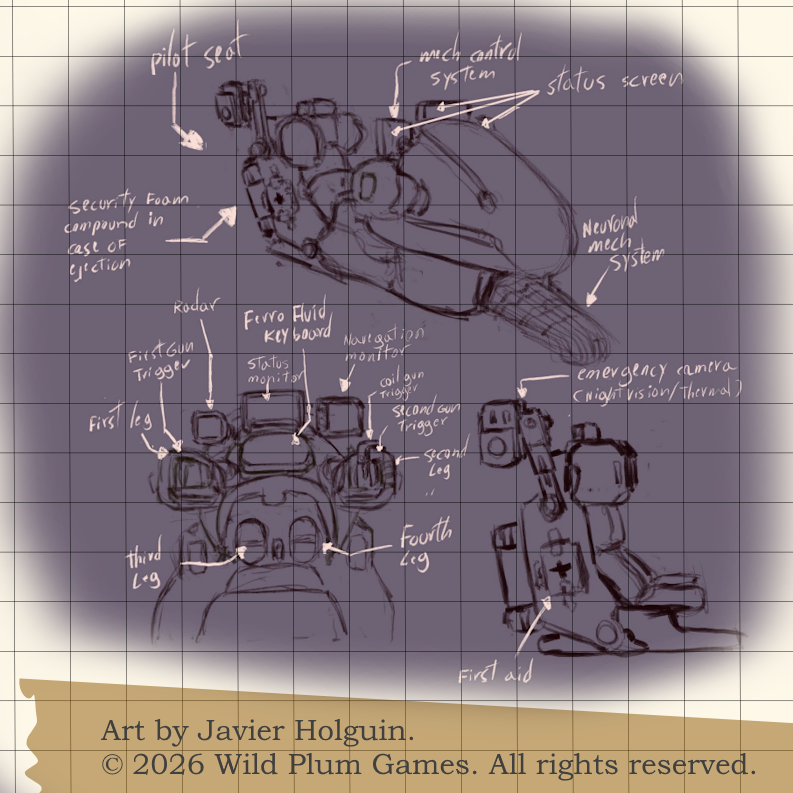
The mechs of Precipice have highly varied control schemes, from haptic cockpits to levers and gears, and the Input-Action system is designed to cover all of them. Because the specific activity behind each Input card is abstracted, what might represent revving an engine on one mech can reflect straining against the loom on another. This is vital for reflecting the varied worlds of the Precipice, and also for giving players the best tools for the Bring Your Own Mech experience.
Quick Turns, Tense Decisions
One of the goals of Precipice was to have turns that resolve quickly enough to support games with 3 or more players. Many miniatures games struggle to incorporate a third player because of the long downtime between meaningful actions (and even card games can suffer from this design hurdle). Players simultaneously and secretly plan their actions, then alternate resolving those actions over the burst. Each action needs to be able to resolve quickly, even though a mech might take a flurry of different actions during the burst.
Learning the Controls
The Input-Action system is flexible from a design perspective and creates tense play once a player has internalized it, but like all design decisions, it comes with tradeoffs. In this case, the primary tradeoff is one of player education. The very flexibility and opportunity for skill expression baked into the Input-Action system also makes teaching players the flow of the game a bit trickier. When a game commits to a fixed flow of play (“Move, Shoot, Attack”, etc), you can explain each step in turn. But when one of the player’s main choices is selecting their own pattern, a chicken-and-the-egg problem arises: you need to teach the player how to execute actions, but also why their choice of actions matters.
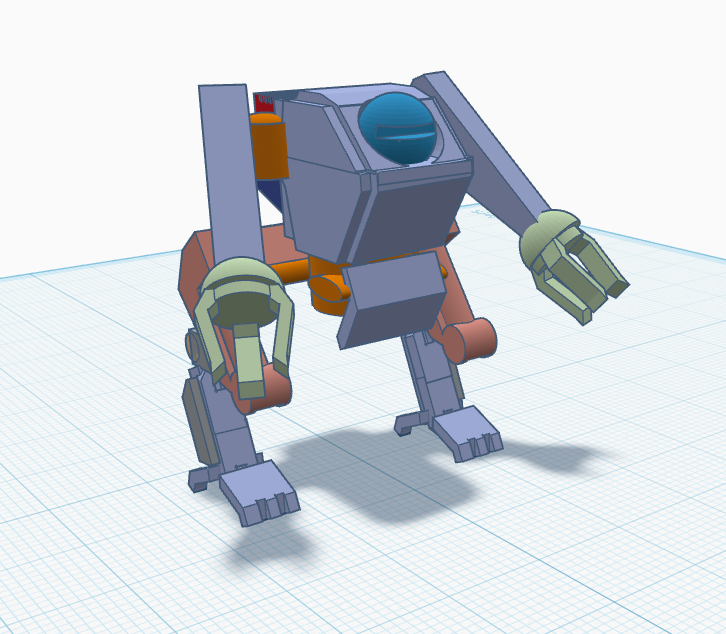
To this end, we have created an encounter to help players learn the controls: Crash Course. This encounter can be found in the Open Alpha resources, and puts the player in control of an L-Trak. While this machine is less than agile, getting it through the course will help you to learn the basic concepts of mech movement in Precipice! Just make sure your pilot’s insurance covers two-legged vehicles.
Receiving Feedback
So, what feedback have we been getting on the Input-Action System? The biggest one is this: people want to customize their available inputs! And that makes sense! Pilots are, after all, your means of interacting with the game world, and characters who should have personality in their own right. But pilots aren’t currently customizable. All we’ve had so far is the Test Pilot, and their standard set of Input cards. Not the most inspiring choice, but a good one for testing game baselines.
A lot of players have reported wanting two copies of a given input (pretty much always the “5”, specifically to be able to shoot 3 times in a burst). That’s definitely a design space the game could explore, but it also has its risks. For starters, if you trade a “2” for another “5”, it might make certain pilots very hard-pressed to pilot certain mechs effectively. If you just add a “5,” that pushes up the overall number of available Inputs, which has impact on the action economy of the game.
This is design space we’re excited to explore in the future. While it probably won’t appear in the forthcoming Open Alpha 1.2 Update, expect to see it in the near future!