
Fiction Primer: Control Schemes
Precipice is a game that focuses on “Jumping into the cockpit,” and that means you need to have an idea of what the cockpit looks like. The game asks you to imagine your own hands piloting the mech when you plot your inputs and execute your actions. That means helping you build a mental image of what’s going on inside your mech.
But different mechs can have wildly different control schemes. If you’re bringing your own mech, you probably have a concept of its levers and throttles, mind-machine interface, or big display of red buttons with inconsistent labels.
For the original mechs appearing in Precipice, we knew that we’d need to really flesh out these concepts. This made discussing and determining the control mechanisms for each world’s mechs in detail, even beyond what has appeared in the fiction so far. So today, we dive into the control systems seen in the mechs of Arbelos, Swarmworld Arcturus, and Harness!
Analogue Cockpit (Arbelos)
Engaging the control grip for the utility arm, Auglez gently reached out and secured the hauler’s arm to the damaged track. Lodi gestured upward and Auglez pushed the grip up a few centimeters. Metal groaned in protest, but the hauler gradually winched up the tread so the engineer could duck beneath.
“That’s some deft handling. You got the arm to secure in one go. Usually getting a precise grip like that took me a few tries.”
Auglez shrugged. “Been at it a long time.”
“Well, I’m impressed. The manipulators on that V-series utility arm are really finicky."
“You really did see some action, didn’t you, cameraman?” Auglez asked.
From Arbelos Chapter @: @@ by Max Brooke
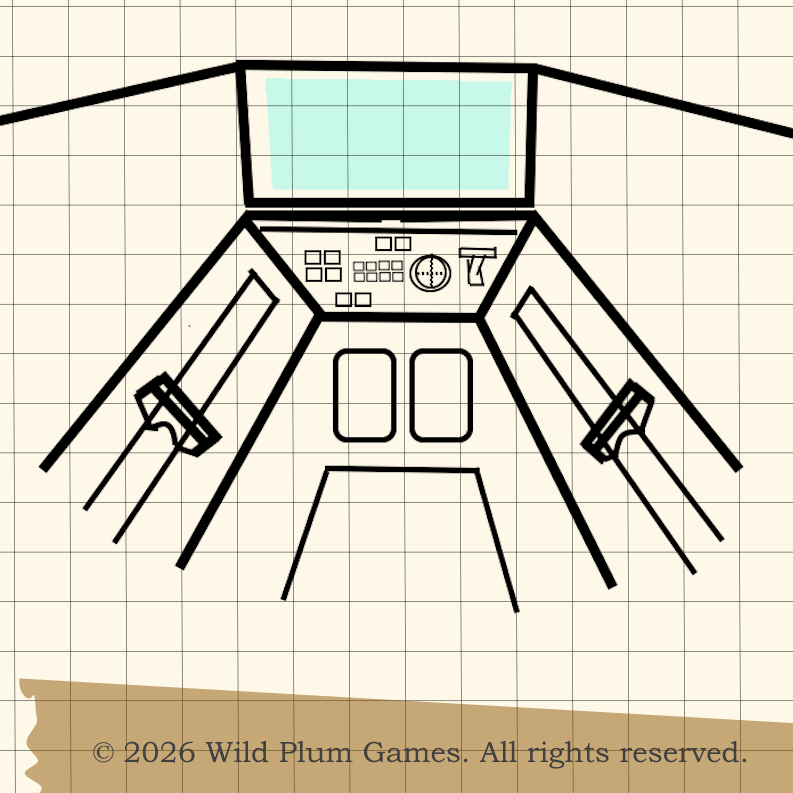
The cockpit of a trak is cramped, filled with specialized levers and switches and the smell of oil. While a contemporary M-Trak has a somewhat smoother interface than its more rudimentary U-Trak ancestor, with more of the control of the mech handled by mechanical computers, the whole system is still very manual. The seams of the interface are constantly visible, the grain of the monitors and gaps in visual perception a constant reminder of the separation between machine and body.
Control Sleeves (Swarmworld Arcturus)
Maris reaches into the gauntlet-like control sleeves and gropes around inside for something—anything. Her fingers find the stippled texture of a cylinder, about the length of her palm; it fits nicely in her hand, like a bicycle’s grip. The sleeves tighten around her forearms, securing halfway to the elbow. The faun stops moving. The control sleeves around her arms and legs tremble anxiously.
“Weapons. We need weapons.” Maris looks around the cockpit sphere for a sign of anything that looks vaguely weapon-like. She’d seen images of the interior of faun control spheres before, but they always had clusters of monitors showing the status of various systems, control yokes with triggers for cannons, and heads-up displays overlaid on external camera feeds. All of that gear was added by humans, though. In the nameless faun’s sphere, there are only the control sleeves. It feels disconcertingly less like helming a giant machine than floating in a pressurized void.
From Swarmworld Arcturus 2: Gilfaethwy by Brandon Perdue
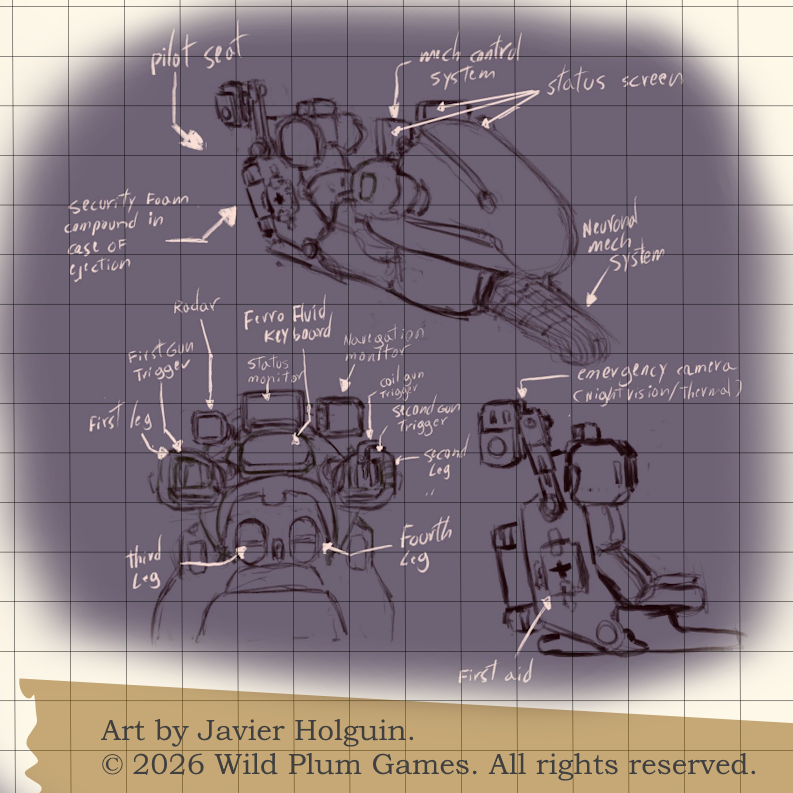
Swarmworld: Arcturus has decidedly different questions to ask about the mechs and the body. In the Arcturus Swarm’s blooms, mechafauna have personalities and wills of their own, albeit ones too alien to easily decipher. But perplexingly, they are also equipped with cockpits which are almost too compatible with the recent human arrivals. Though the mechafauna were created by the Swarm Builders, an unknown alien species long departed from Arcturus, their haptic controls are intuitive for the human mind and ergonomic for the human body-plan. Even an inexperienced pilot like Maris can guide her faun in a tense combat situation. On the other hand, any pilot’s control is limited, tempered by the faun’s own instincts and priorities (this is going to be a lot of fun to represent in game mechanics!).
Of course, humans being who we are, the people living on the swarm have added all sorts of technological features to fauns, from enhanced controls to additional sensor systems to deadly new weapons. For their part, the fauns seem to tolerate these modifications, offering no clear opinion on enhancements of their form meant for human convenience.
The Loom and the Plinth (Harness)
The lantern holder suspended her light from a cord and looked at Orlondo, expectantly. The other page, a sandy-haired boy, spoke. “Uh, Master Orlondo, you must step onto the loom.” His title still felt jarring.
The first page reached around Orlondo’s sides, swinging a pair of hinged, pulley-block armatures into place along his arms. The second page swung a similar pair into place behind Orlondo’s legs. Cunning joints suspended each armature, while allowing multiple thick cables to run through the channels of its blocks. Each armature connected at swivelling joints to the solid, hardwood panel that hung down behind him like the back of some great chair without a seat. The cables continued from each armature's leading end, strung taught to pass through a receiving block and into the gearing mechanisms of Gatewatcher’s closest limb. It reminded Orlondo a little of the ships’ rigging he’d sketched at the Riverport for a time, but vastly more intricate.
Orlondo stepped up to place his booted feet on the wooden, sandal-like platform of each leg armature, resting the backs of his legs on thin, leather cushions. Then, he placed his arms along their armatures, inserting his hands into the gloves of an articulated gauntlet attached to the end of each arm, similar to those on Delphia’s foot harness. Finally, he gingerly placed his head within a gesso-hardened, cradling leather helmet suspended from its own armature.
From Harness Chapter 2: Raised Up by Michael Gernes
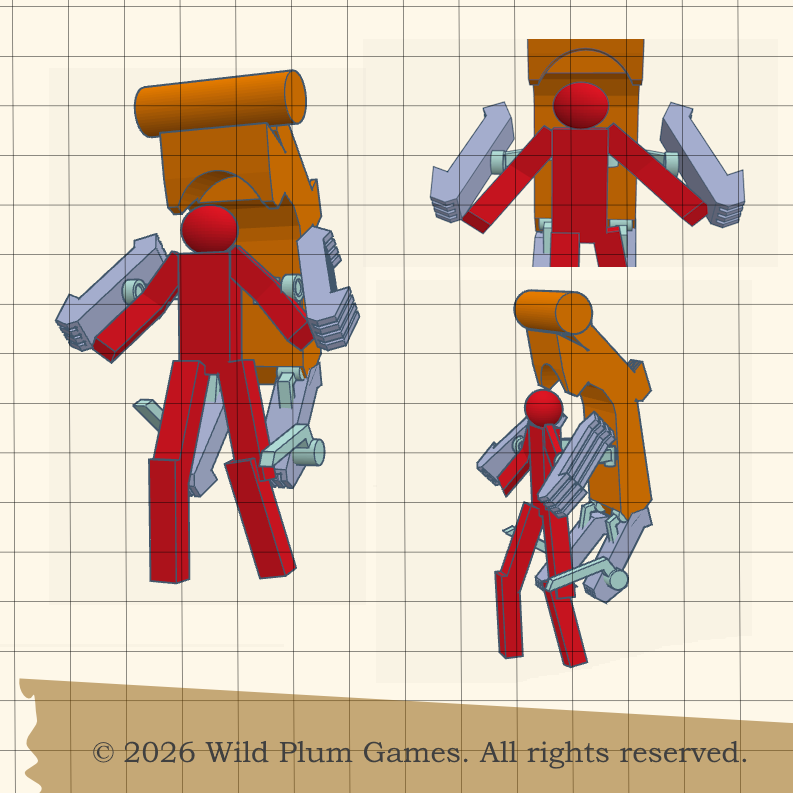
Connected to a set of worn parts within the great harness, the loom iterates on mechanical innovations in fabric-weaving technology to transmit the wearer’s movements to the great harness. The harness bearer, housed in the chest, cannot look directly out, but instead uses an array of mirrored lenses to watch the battlefield “through” the eyes of their machine, moving their body spur the great harness to life.
But no less important to control is the plinth, without which the harness bearer’s movements could not move the massive gears within the great harness:
Orlondo had never been this close to a fragment of the city’s plinth before. Let alone past the Hollow Tower’s barred gates, where its ancient remnant sat. But he knew a platter-sized section lay beneath the box’s lid, waiting to be interred in Gatewatcher’s reliquary. Cante had said it was the largest carving from the plinth in forty years.
The herald hemmed audibly and darted her eyes to the box, prompting Orlondo again. Then he quietly repeated her words, finishing more loudly: “I swear these vows upon this sacred stone of Premonta, in sight of the Divine Well, and the God Beyond it.”
Finally, Orlondo placed his hand over the box, and immediately felt an odd flicker-pricking where his fingers rested on the velvet. The sensation flowed up his forearm and his muscles twitched as it moved across them. In a blink, his arm was limned in a flickering trail of green fire. For a moment, he wondered at its coldness. Then he squeezed his eyes shut as pain and images flooded his head. Tears welled up, and he was many places at once: down among rain-splashed cobbles; looking over a red-roofed city and its golden countryside, as if from a mountainside; deep in a stone shaft as the last sunlight sank over the lip above. It all fled quickly, but as he blinked, the image of the green flame remained.
From Harness Chapter 2: Raised Up by Michael Gernes
Housed in the reliquary (usually on the great harness’s back), the plinth deepens the bond between harness and bearer in ways not entirely understood by most. The plinths are among the greatest treasures the city-states of the Peninsula hold, and are both civic resources and objects of religious veneration. This makes each great harness a potent emblem of the community needed to create and power it, from artisans to engineers to clergy. When these symbols meet on the battlefield, warring factions are not only testing their champions against each other, but symbolically placing their entire societies on the scales of war.
Other Systems
Of course, these are just a few of the mechanisms for controlling mechs in Precipice. In the coming months, we’ll revisit this concept with two more very different visions of how pilots interface with their machines!