
Studio Update: Wild Plum Game(s) Jam 2026!
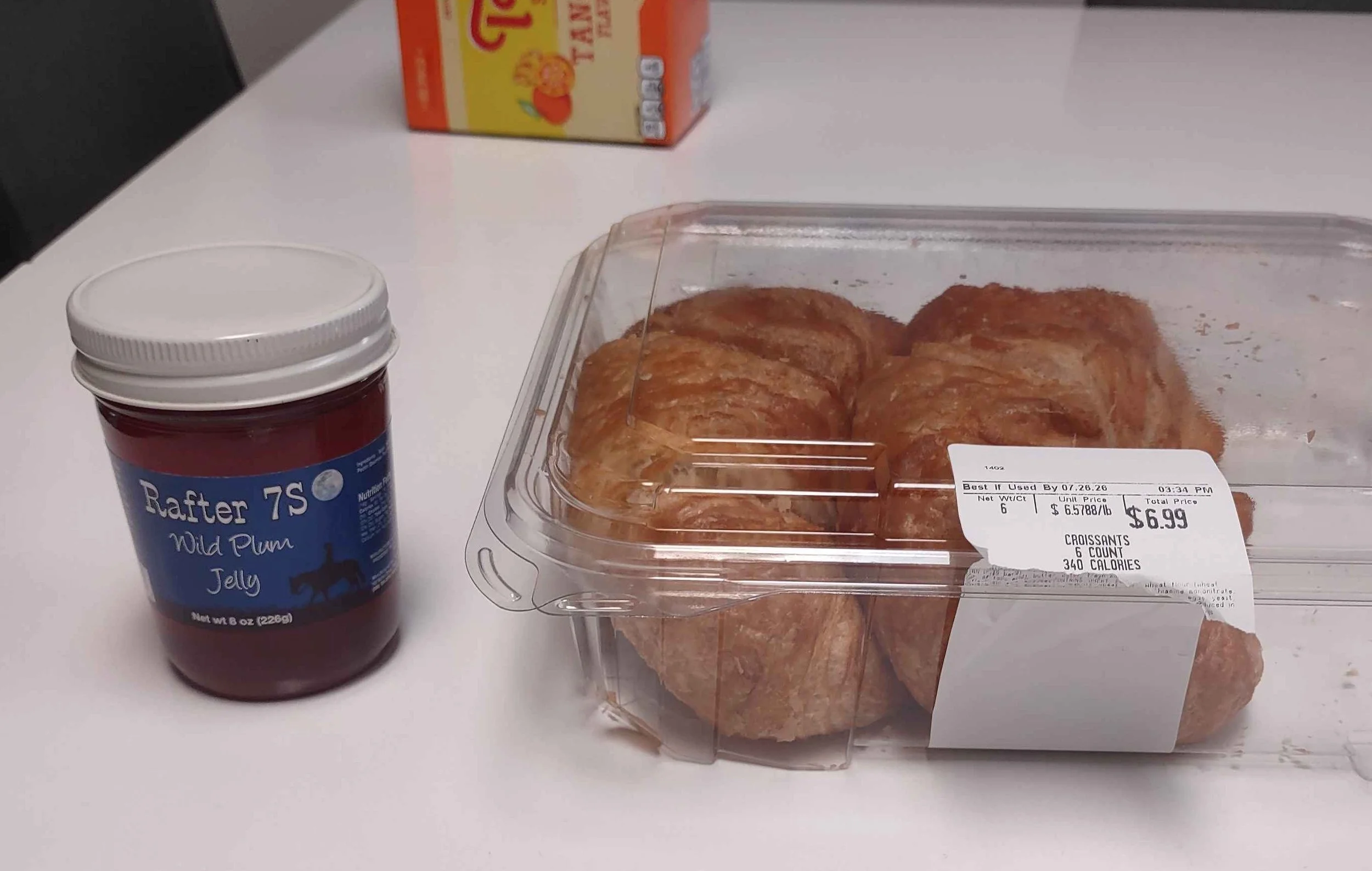
Last Friday, Wild Plum Games held what I hope will be the start of an annual tradition: a yearly game jam! It was a small group, but creatively productive in some awesome ways. Today, I’ll tell you about it! We started with thematic snacks.
What’s a Game Jam? And Isn’t that Jelly?
A game jam is a gathering in which people sit down and make a game prototype in a hurry. Usually, there’s a time limit. In our case, we had from 2:00pm until 7:00pm. Importantly, the goal is to finish a prototype, not to make a good game. Making a good game is (usually) a long and painstaking process. But it’s easy to get stuck in the details of “is this good?” even early on, when ideas should be flowing freely and quickly. Much of what I get out of a game jam is liberty from worrying about “good.” It’s a chance to be creative without worrying about whether something will sell, or be balanced, or even be fun. Sometimes, you do get an idea that is worth the painstaking work of polishing. But even if you don’t, the game jam carries on. Just get the prototype done!
So yes, that’s jelly, not jam. But we couldn’t worry about that kind of detail, because we had a prototype to finish!
Creativity Exercises
Once we’d cleaned up from the jam-and-croissant rampage (jampage?), we leapt into some creativity exercises. I chose to start with these because I thought they would be fun, but also because Andrew Fischer did this at the Fantasy Flight game jam he ran many years ago, and I thought it worked really well then.
I couldn’t actually remember what the specific exercises we did back then were, though, so I made up three new ones.
The topics were:
What is a really cool mechanic from a game you didn't like?
Pitch a terribly mismatched concept for a licensed game.
What is a really disappointing mechanic from a game you did like?
Since it was a small group, I staged these as open discussion topics and wrote down key ideas and thoughts that arose during the discussion. These note sheets gave us a set of ideas for the pitch.
I was going to post a page of the ideas for the bad licensed tie-in games, but a bunch of them probably shouldn’t be preserved for history. “No bad ideas” doesn’t mean there are no bad ideas, just that all ideas are accepted at this stage. My favorite was the Land Before Time Grand Strategy Game. Although “Root with (More) Dinosaurs” would probably be awesome…
The Pitch: Save Scum Superstar
Talking through the ideas, one interesting problem that arose in both games we did and didn’t like was the matter of stakes. If the cost of failure is too low, tension remains low. But if the cost of failure is always a full game state reset (“you lose”), paradoxically, stakes can also feel too low, because you’re resetting to some prior state all the time.
Many digital games simply accept this, with “save scumming” (returning frequently to prior states) being an accepted mode of play, or even mechanized formally through an in game (and/or in-lore) respawn system. A few tabletop games have played in this space as well, but because of the friction of physically resetting an even moderately complex board state board, it’s rarely mechanized to the same degree.
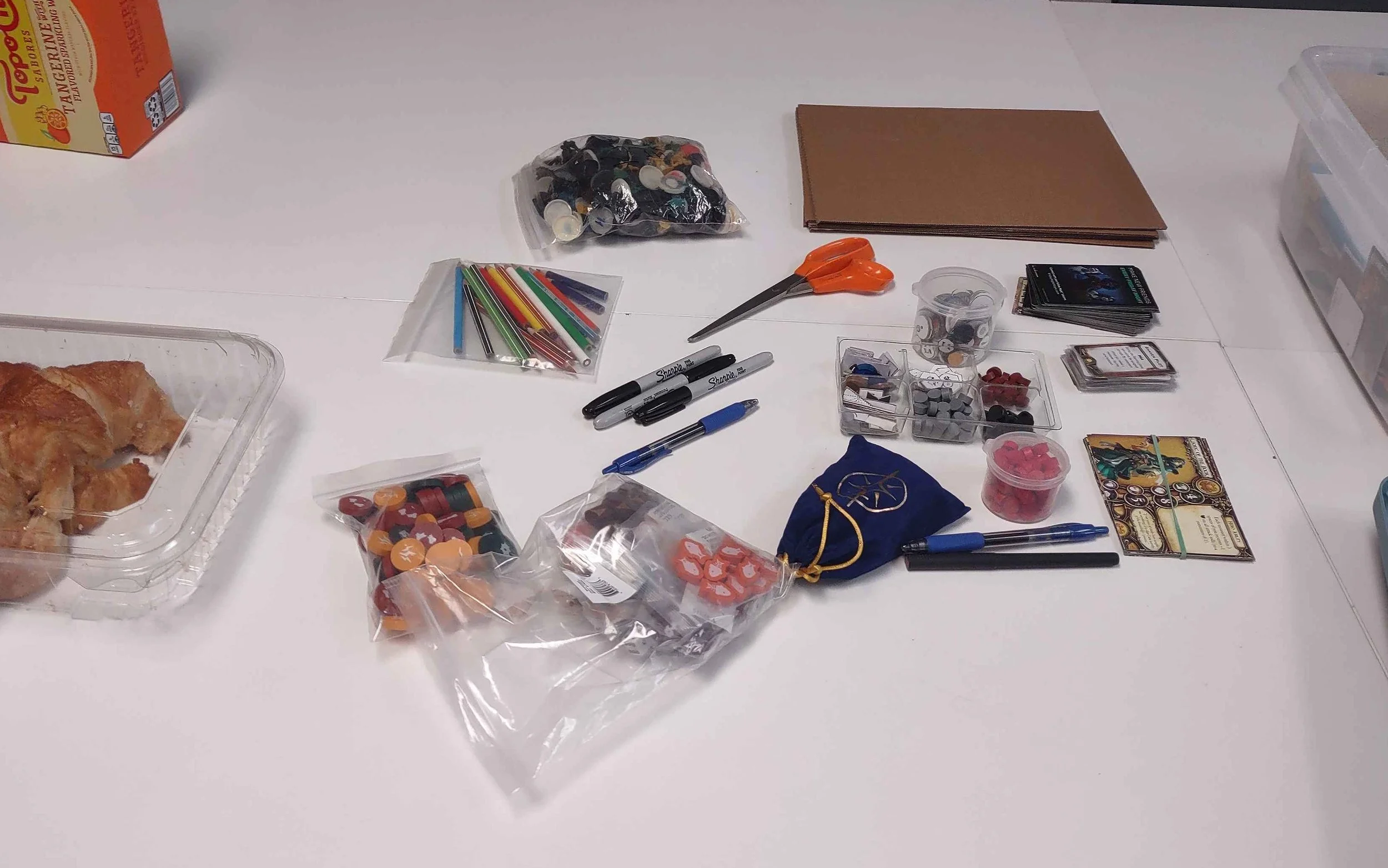
This gave us a premise and a design constraint. The premise was “a game would be about save scumming.” The design constraint was that the game would need to be “reversible;” at any time, you’d need to be able to “roll back” easily to a prior point in the game. We threw a bunch of components raided from other games on the table and got started!
Rapid Iteration
The first concept was a single-player “inventory manager,” where you laid out tiles matching nodes, riffing on the mech building in Precipice. We slapped post-it notes on some old tiles I had from a prior prototype to get things moving quickly. I started drawing crude art, and we were off to the races!
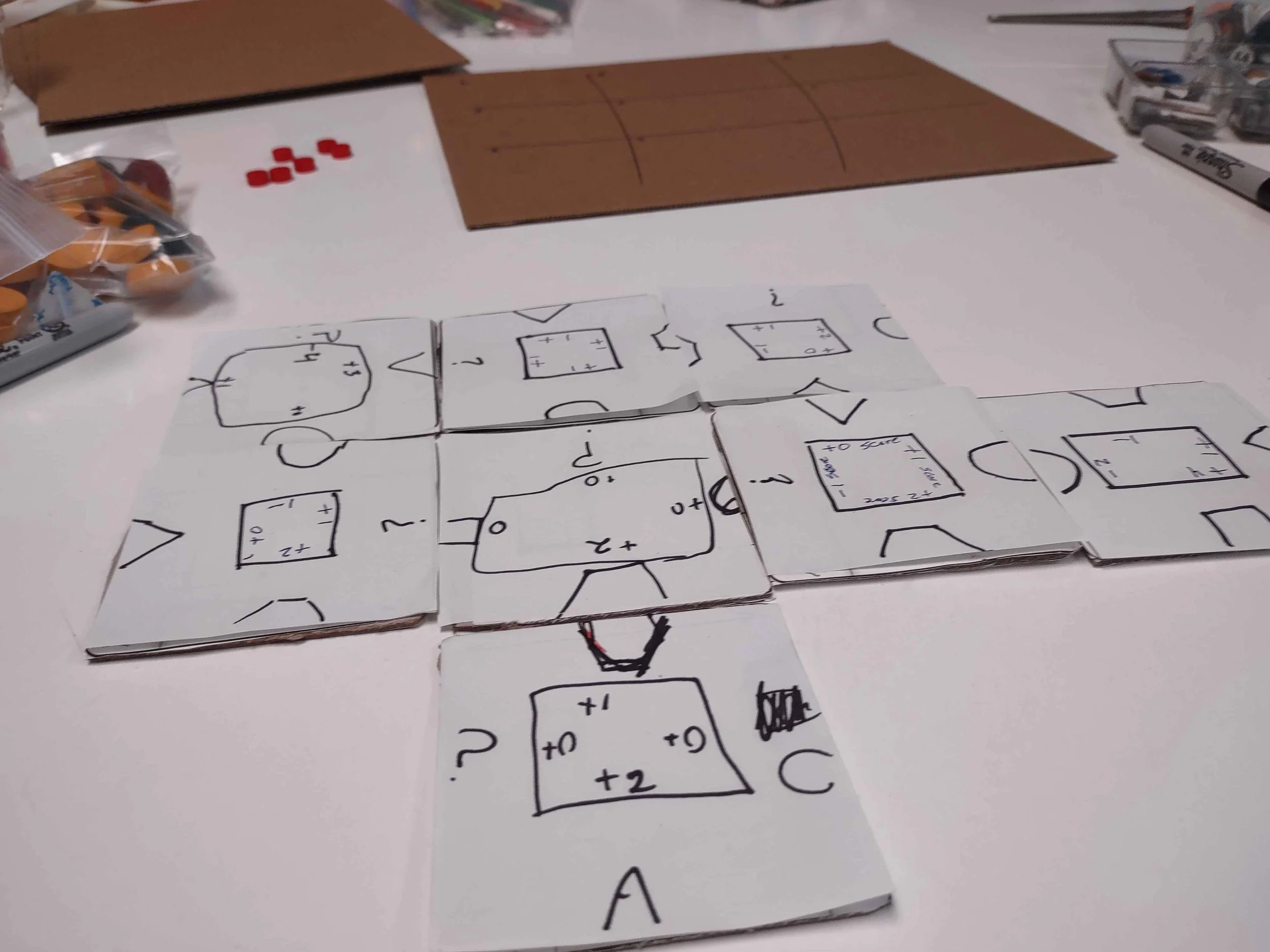
The idea was that you drew tiles from a deck and placed them into a numbered grid. Each tile had nodes with shapes (or the wild “?” symbol), and pairing nodes had some effect. At any time, you return any number of tiles to the deck (in the order you placed them, thanks to the numbered spaces) and try again. We quickly cycled through a number of incentives and structures. First, some orientations of the node mattered, then only matching nodes scored, then we dispatched with the grid and tried to find a different way to track order (we did not succeed).
After about an hour of prototyping and play, we had a few conclusions:
This simple optimization puzzle wasn’t grabbing us.
But the line/grid placement aspect had potential.
We still wanted to explore the “save scumming” side of things.
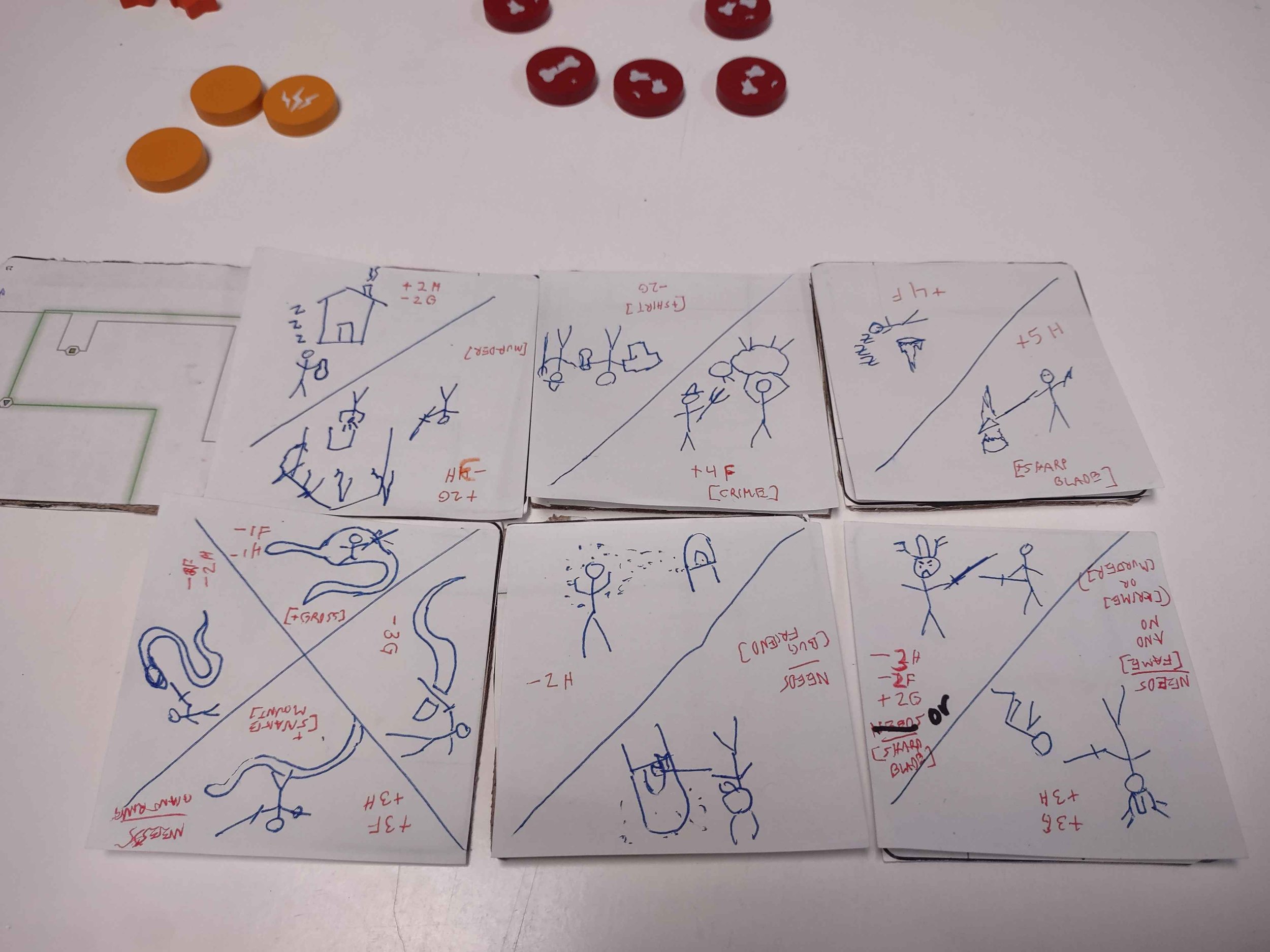
With this in mind, we decided to chuck the inventory management concept. We went for a simple, easily recognizable pattern instead: an adventure simulator! Further, we simplified the card interactions. Instead of tracking nodes, each card would simply reflect a choice facing your character, with its position reflecting your decision. To support the theme, we added in a basic resource system: Health, Stamina, and The Other One (gold, then “influence,” then “reputation,” then gold again, then “TBD”).
I drew furiously while other people filled in mechanical effects for the art (such as “befriend the bug-person”/”fight the bug-person”). We started adding tags to some cards which would trigger on future cards (for instance, having the [Bug Friend] would allow you to avoid being stung by bees, later).
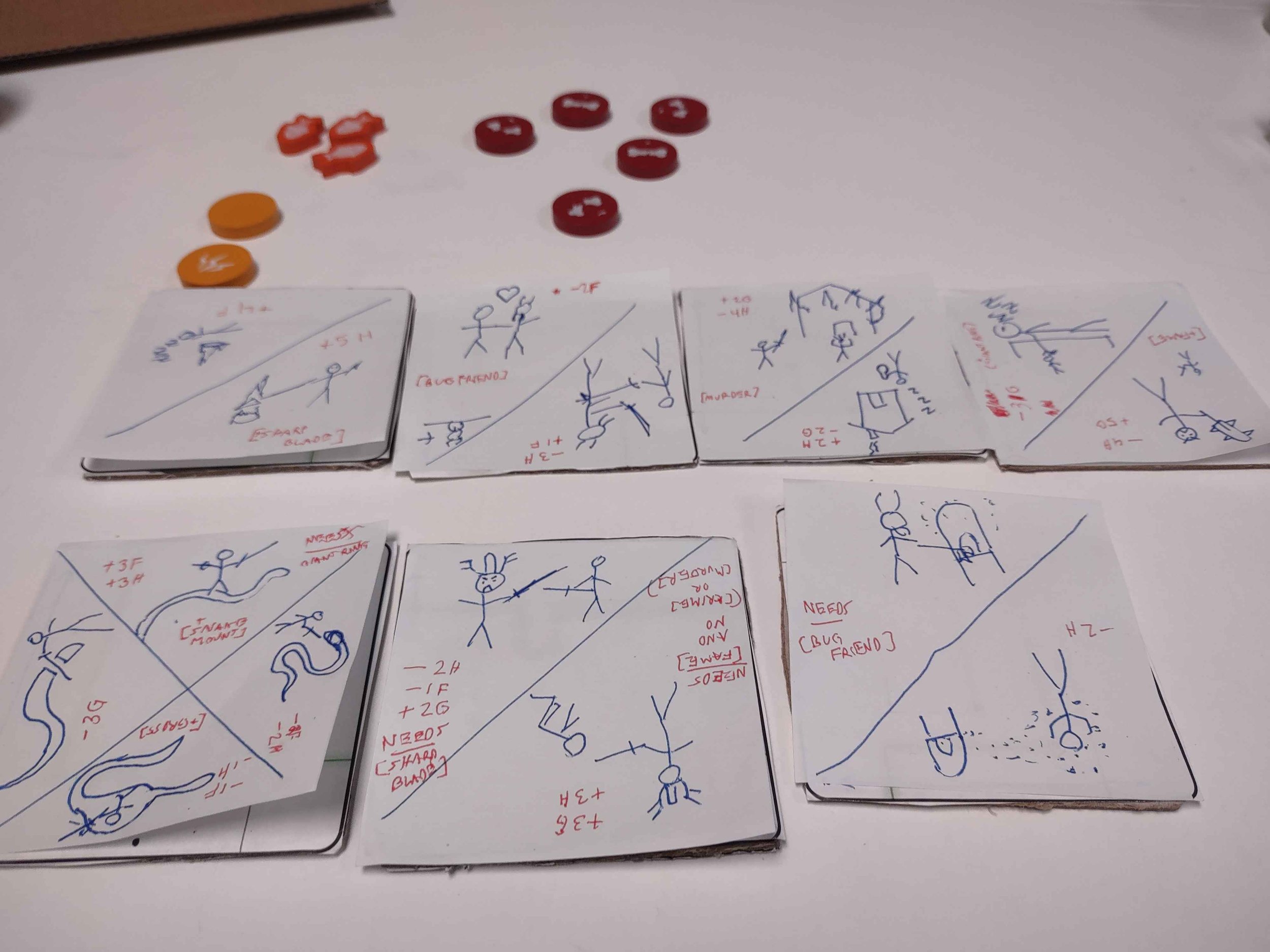
The cards were staged into two decks: Chapter 1, and Chapter 2. Rather than making a ton of cards, we made just the bare minimum required for a minimum viable prototype. Within half an hour of settling on the updated concept, we were playing the new version. Here were our findings:
Even tiny decks actually provided a fairly differentiated experience on 1-2 playthroughs. Larger decks would probably provide a lot of variance of experience, provided that…
The art could carry the concept. The silliness of the stick figures made drawing and placing a new tile pretty satisfying, actually. With a good artist, this concept had legs.
The payoff tags felt very good.
The “solveability” of the puzzle was a question-mark. With the ability to reset freely, the game always ended in one of two states: completion or an inevitable dead-end.
I had us try a very quick experiment, and whipped up some de-themed versions of the cards. We only had to put a few down to see our problem: the base puzzle was too easy if you could reset infinitely, but too random if you had no resets. We’d walked ourselves right into the original problem we set out to engage with!
Resetting our Concept
As with the player of our game, we had a theoretically infinite number of resets. We could start over from scratch, if necessary. But between iterations, art, and walks (got to keep that blood flowing!), it was about 5:00pm, and we were flagging. So instead, we asked: what if we reboot the premise?
The game went from Save Scum Superstar to One Reset Roguelike. By giving the player a single reset, we still took advantage of the interesting aspect of a clean reset in an adventure simulator. But we also kept the puzzle feeling (somewhat) challenging, since you had to pick the right time and way to reset. Unsurprisingly, we did not “solve” one of game design’s largest thorny problems in one afternoon. But we did make a game!
Is this Good? Is this Anything?
One Reset Roguelike doesn’t stand up to many playthoughs. But in its defense, it only has like ten total cards. When we put it in front of new people, we got mildly positive reactions. People responded to the stories the choices created, and felt ownership over those choices. So I do feel confident that it is, in fact, something. I’m sure if I look into it, there are other games out there that are already doing this something, but the beauty of the game jam is that it doesn’t have to be more than an exercise.
I could see myself revisiting these concepts. Character creation in an RPG with a gamified lifepath system springs to mind, or a subsystem in a larger game like Stonesaga. Between the tags and the three tracked resources (four with the one “reset button”), One Reset Roguelike has a lot of outputs that could feed into a larger ecosystem of some kind. Sometimes, an idea that doesn’t work stand-alone is exactly what you need to solve a problem within a larger context.
Process as Art and Art as Process
The idea for this game jam came about when a good friend of mine asked me to explain my creative process for new game creation to him. I started blathering on about it, but I quickly realized that (even with the time needed to schedule an event), it’d probably be faster and more illustrative to just show him. The process isn’t always easy to articulate. This is in part because it varies a lot, and in part because much of it is intuitive. So it was a lot of fun to slow things down, record the process of creation, and reflect on it a bit. It’s easy to think of art only as output (even/especially if you work on art), but the process is inextricable from that output. Every game is every step and misstep of its creation.
I hope to do this again in years to come!