
Mechanics Update: Searching for the Heart of Encounters
Last week’s Mechanics Update got into some of the ways the initial and rather barebones take on Encounters in Precipice have been straining under the needs of the system, along with some thoughts on how they will be evolving. This includes specific elements, like the use of a standard poker deck for certain randomization to allow for unequal information (a player whose mech scouts an enigma can discover and record its nature without telling their opponent). It also includes a higher-level evaluation of what an encounter represents, and how it should present incentives to players that influence their decisions.
The Heart of the Experience
I’ve expounded in the past on the tensions that can arise between the following questions:
How do people play a given game?
Why do they play that game?
Scenario design sits right at the intersection of these topics. By giving a player the means by which they progress the game state, encounters are setting forth the stakes for both the strategies that win (the how) and the fantasy that causes them to actually set the game up and play it (the why). Though the scrutiny inherent in competitive play will always create some divergence between the two, one major goal of a scenario is to harmonize these two things as much as possible. In simplest terms, a good wargame scenario guides the player toward a patterns they will enjoy, then rewards them for following it.
So, how do you find the heart of the game experience? You play it! Even if it’s just chicken-scratches on a notepad.
Firsthand Experience
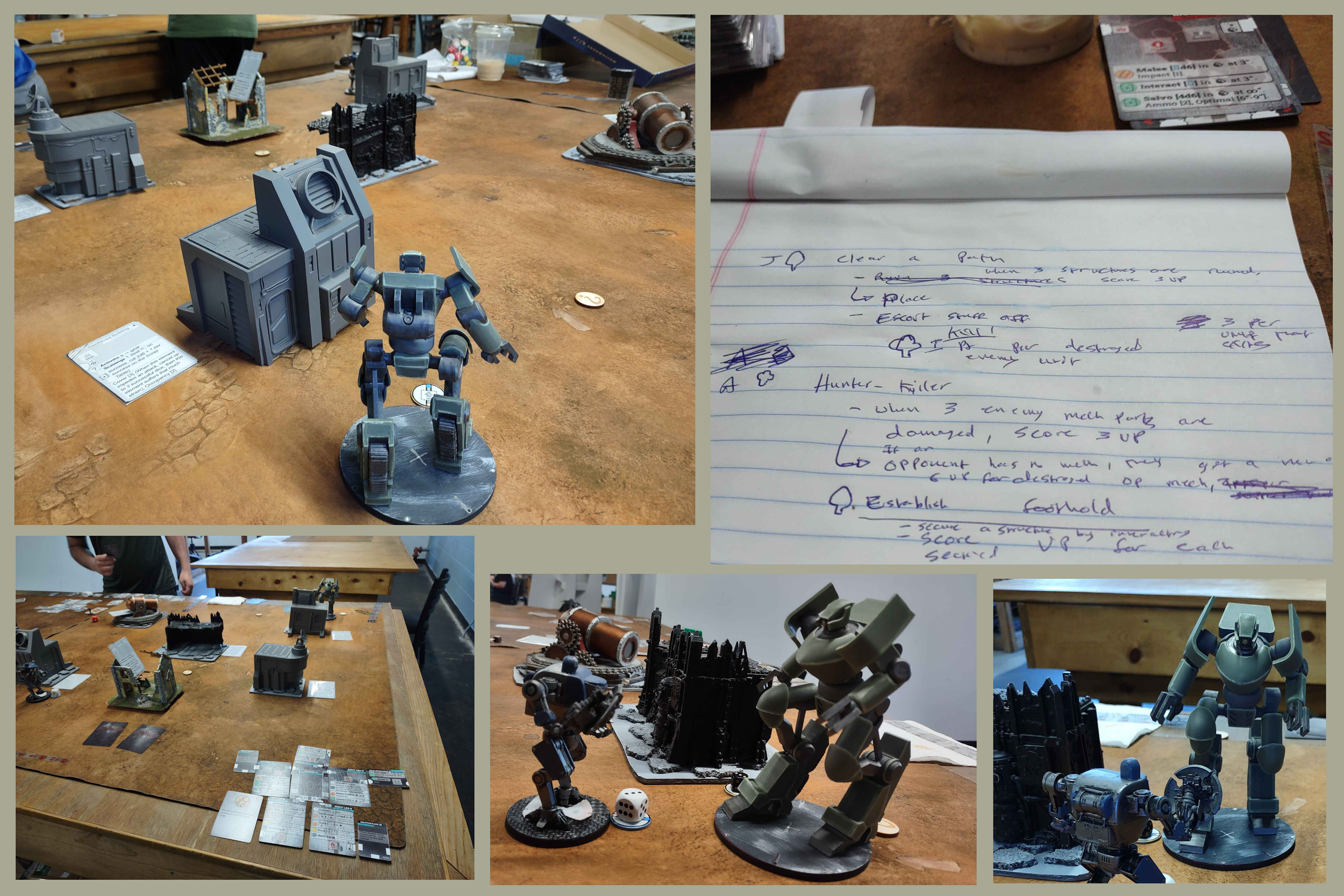
For this encounter, we each had a mission, kept secret from our opponent and based on a playing card we drew at the start of the encounter. The suit of the card determined the type of mission, while the number defined its exact nature. My opponent “drew” the Jack of Spades, and I “drew” the Ace of Clubs. In fact, these were the only two missions that existed; gotta keep those minimum viability tests moving.
Each mission had a preliminary phase, which could be pursued while the mission was secret. Once the player had fulfilled the preliminary phase, they could move on to the open phase, revealing their mission to show the criteria needed to score even more victory points.
Each mission also had a vulnerability, a set of additional criteria that the opponent could score based on the suit of their own mission.
The two quick-and-dirty test missions for this encounter were:
Clear a Path (Jack of Spades)
Preliminary: When three structures are ruined, score 3 VP and reveal this mission. Your opponent places an egress at 2” of any ruin.
Open: When revealed, place 2 haulers (smaller mechs) at 6” of your threshold. When one of your units exits the encounter at 2” of an egress, score 3 VP.
Vulnerability (Clubs): At the end of the game, your opponent score 1 VP for each of your destroyed units.
Hunter Killer (Ace of Clubs)
Preliminary: When 3 enemy mech parts are damaged, score 3 VP and reveal this mission.
Open: When revealed, if your opponent does not have a mech, they may place one from their hangar at 6” of their threshold. When you destroy an opposing mech, score 6 VP.
Vulnerability (Spades): Opposing units can Interact to capture structures. When a structure is captured, mark it with a token. When the game ends, they score 1 VP for each captured structure.
So, How Did the Test Go?
For the first several rounds of play, I moved my mech quickly toward my opponent while he levelled structures. Unfortunately, I brazenly ran into an enigma (also revealed with cards). Without scouting the enigma, we revealed both cards immediately, and I discovered a volatile structure with a hostile Harrower inside. This small unit peppered my mech with fire, and so I was forced to level the structure to remove it, “unknowingly” contributing to my opponent’s goal.
When the haulers appeared, I hadn’t managed to score three damage on my foe’s mech. In fact, because of the damage my mech suffered on the way in, I found myself losing the battle of attrition! So I decided to focus on denying victory points (and score some points from the foe’s vulnerability), breaking off from the engagement to hunt the haulers as they raced for the exit.
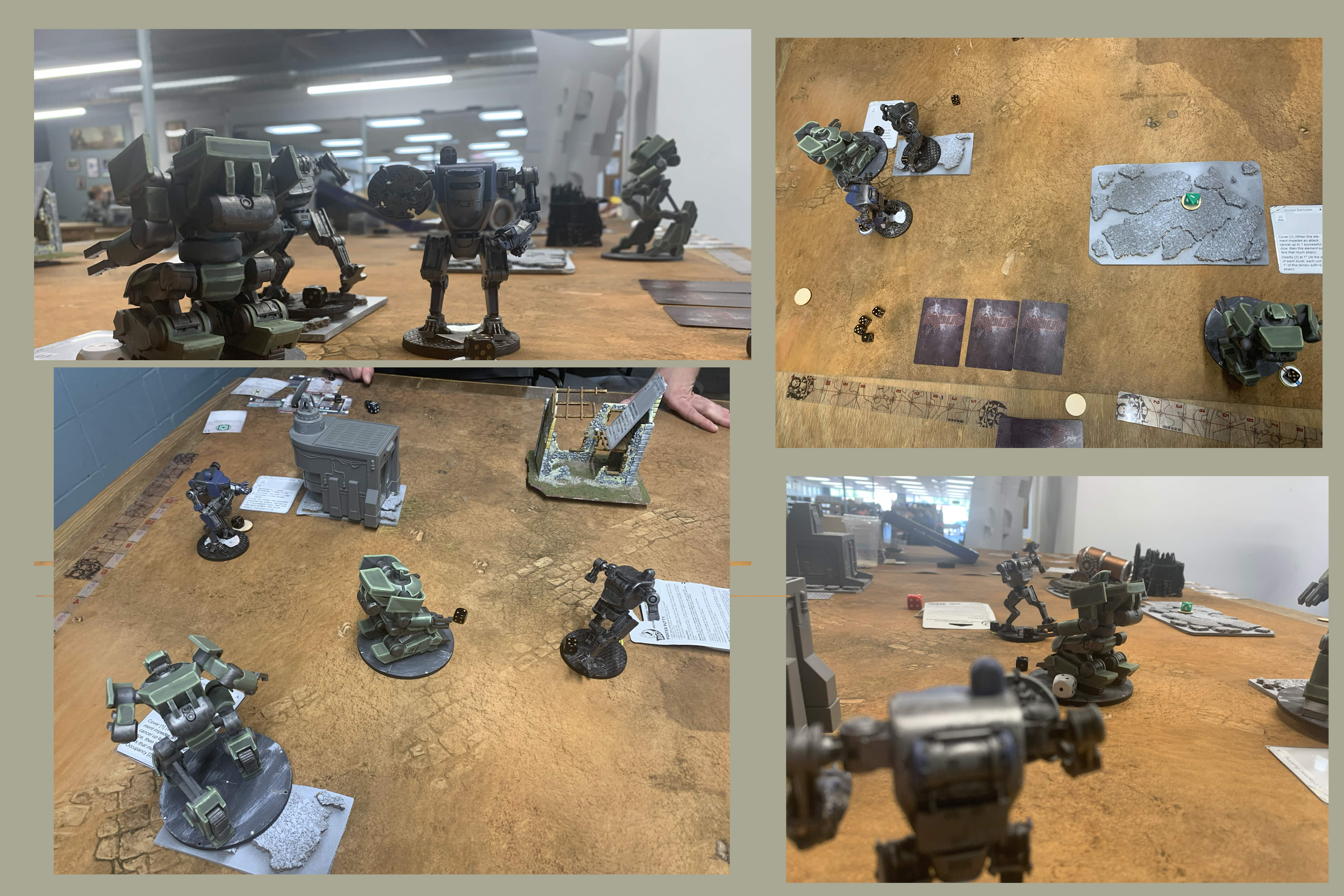
Unfortunately, my weakened mech didn’t quite have the juice to inflict fatal damage on both vehicles before they slid off board. So it goes!
Test Takeaways
My opponent outscored me by quite a bit, and we both agreed that the balance of the encounter was way out of whack. That’s not surprising, or really a problem at this stage of iteration. Asymmetrical encounters always take some sounding out. The important questions were:
Did the actions required to score points engage with the core fun of the game (the fantasy of piloting a mech)?
Did the interaction of our respective missions create an emergent story that was both genre-fitting and enjoyable?
My opponent and I both agreed that the answer to both questions was “yes.” Though these quick-and-dirty missions wouldn’t hold up to scrutiny or repeated play, they did give us something to do that required and rewarded skillful piloting, and the story that emerged had some fairly basic but nonetheless enjoyable twists and turns. It felt like a chance encounter between two forces with very different strategic objectives, and the outcome felt like it stemmed from our decisions in a satisfying way.
When doing exploratory design, the important thing is making sure that the overall structure is inspiring the right patterns of play. So next, the matter is writing that big table of missions! That presents its own challenges, which I’ll discuss in a future update.