
Mechanics Update: Enigmatic Encounters
Miniatures games discourse often revolves around unit optimization, clever strategy, and gameplay tricks. These are the main tools of personal expression available to a player once the game starts. Think of them like individual paints you might apply to a model kit as you make it your own.
And to continue with this analogy, encounter design is the primer used on the bare model that is the game’s core rules. The scenario and conditions of the game determine not just how well the most visible pigments will stick, but also the ways in which they interact and blend. The mechanical premise of the encounter determines a great deal about the ways the game can unfold, and which tools of creative expression will work best. If you’ve ever tried to layer yellow over black primer, you understand.
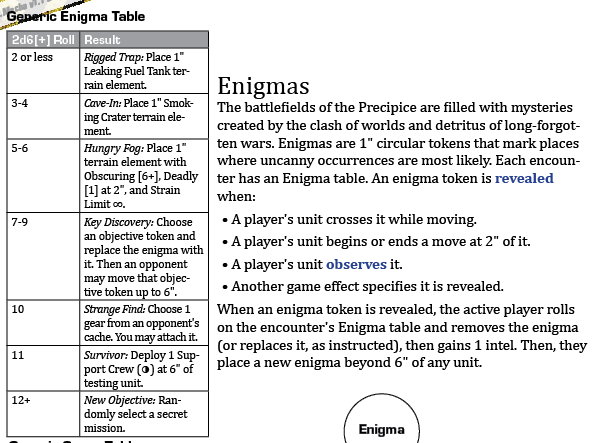
From the start, unpredictability has been key to the scenarios (called “encounters” in the game) within Precipice. In the early stages of design, these included various rollable tables of results for both scavengeable resources and for enigmas, tokens representing strangeness within the Precipice. After all, a domain that touches countless worlds could contain nearly anything. For this aspect of the game to land, exploration needs to be exciting, risky, and potentially rewarding. Uncertainty is key.
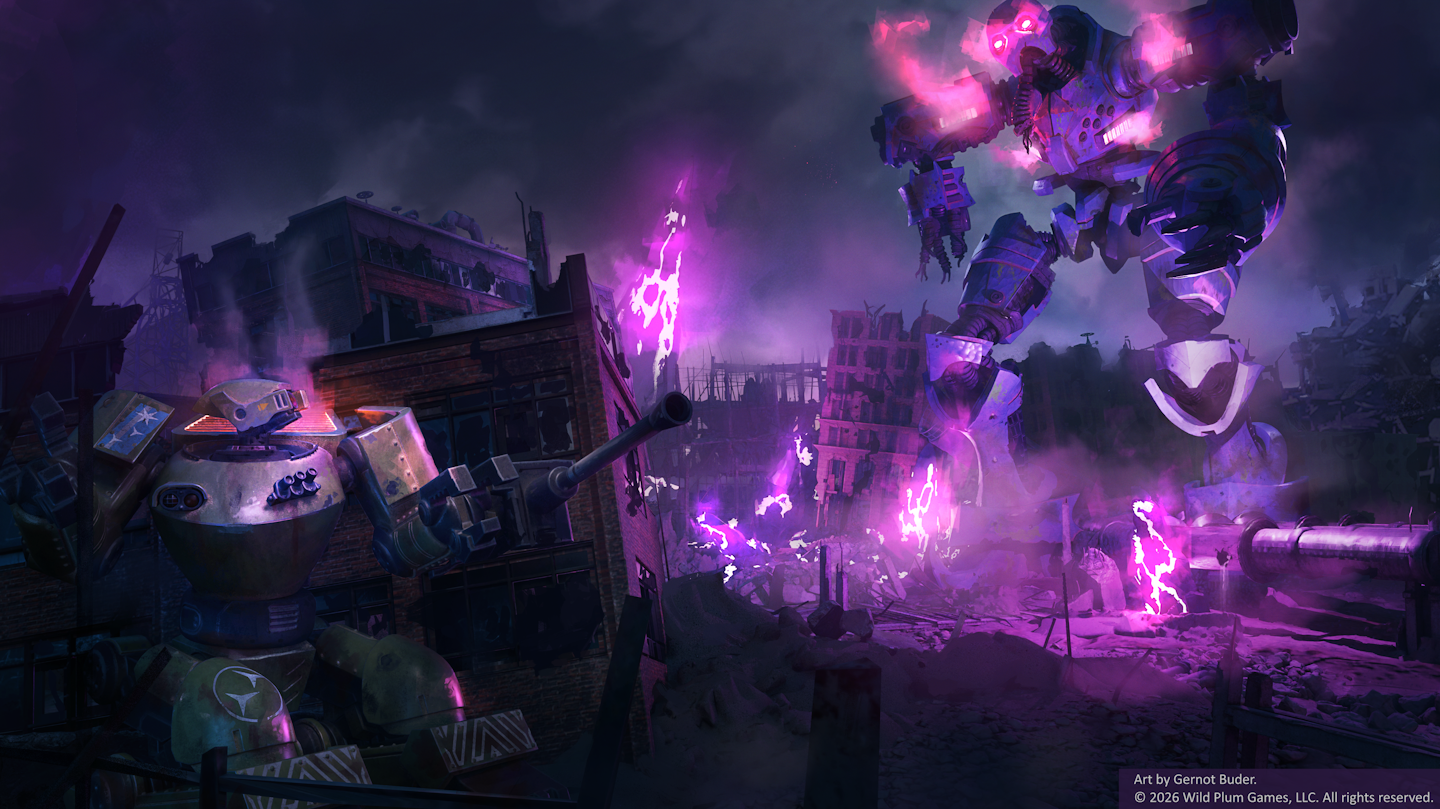
The first implementation of these enigma tables was serviceable enough for testing the core rules of the game. When the driving questions were queries like “is mech movement satisfying?” and “do people understand weapon profiles?”, these enigma tables provided something. At a Minimum Viable Prototype stage, these kinds of shorthands for content are often the best way to get the game to something testable.
But as testing has continued into the Open Alpha, the encounter system and enigmas in particular have increasingly become a pain point. The movement system may be satisfying and weapon profiles may be comprehensible, but what do you actually do with them?
So, as is often the case during iterative development, now is the time to revitalize and improve these systems. The forthcoming Version 1.2 will have a new take on encounters, and enigmas are focal to these revisions.
Encounter Lessons
What has been learned from the current set of encounters available in the Open Alpha? Duel, Recon Skirmish, and Breakthrough have all been put through their paces enough for there to be meaningful findings.
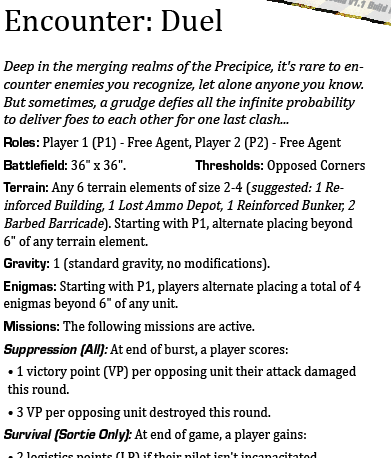
There are a few key takeaways. First off, Duel work pretty well as an introductory scenario. Some players really respond to the simplicity of “get in there and beat up the other mech(s). But other new players have reported that just destroying each other lacked narrative oomph. This manifests in a feeling of inevitability, because even though there are plenty of strategic options, a new player has little reason to execute any but the simplest one (move toward each other shooting, then melee until someone’s mech explodes). Recon Skirmish is much the same as Duel, but for 3+ players.
Some players have exercised more of their tools for expression here, using fighting retreats to keep their preferred distance or attacking terrain instead of the opponent to inflict splash damage, as happened during the filmed demo game with Crabbok. In these cases, emergent narratives have really bloomed. But other times, players have found it hard to make that conceptual jump. Fair enough. Just learning to pilot the mech has nuances, and taking in higher-level strategic considerations at the same time is a lot to ask, especially in what may be a short demo.
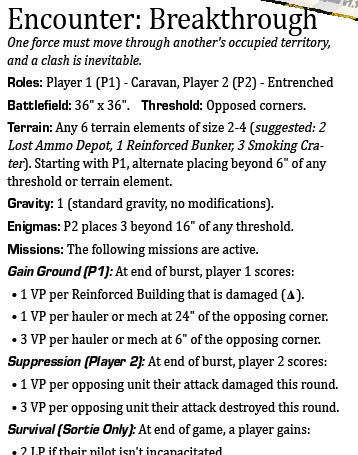
By contrast Breakthrough has consistently tested very well among both new and returning players. Its slightly higher level of complexity means a steeper learning curve, but having several support units gives players a set of fairly transparent choices to consider. Even if the player doesn’t fully understand the strategic layer, they can make choices based on narrative considerations. They might want to protecting their Haulers, or they might callously sacrificing them for gain; both of these choices are narratively interesting, and also function as mechanical avenues to pursue. This encounter seems to basically be working, and you should expect to see fairly close iterations on its basic formula in future updates.
Also of note, the mechanic of secret missions has been a whiff so far. By giving players randomized opportunities to score additional points, secret missions were intended to inject both strategic and narrative direction into the games. They also create ambiguity between players about their motivations, which evokes the uncertainty inherent in several storiesof encounters within the Precipice. However, the implementation of these missions has left players somewhat cold, and they have either tended to feel either arbitrary or ignorable, without granting much narrative backbone to the game.
Enigma Design
Much like encounters overall, enigmas have felt somewhat lackluster. Part of this comes from the limited Enigma Tables available so far, but there have been two much deeper disconnects in many test games. These are:
Players can’t have asymmetrical knowledge of enigmas in the current version. If you scout an enigma through observation or walking into it, it becomes known to everyone at the table.
Enigmas don’t meaningfully contribute to either open missions or secret missions.
Together, these factors have left enigmas feeling ancillary and made exploring them a feel like “waste” of actions in many circumstances. Efforts to mitigate this by introducing links between enigmas and missions have been largely unsuccessful because of their random nature. When asked to choose between “find out something that might be useful” and “shoot the enemy,” people rightly start hammering the trigger.
Fortunately, a couple of deep post-game conversations with longtime collaborator Brooks Flugaur-Leavitt shed some light on directions to take. I had initially been resistant to use two-sided tokens for enigmas in Precipice, out of a desire to keep custom componentry required to play the game to an absolute minimum. Brooks helped me troubleshoot some other options, and she suggested looking at the standard 52-card playing card deck as a randomizer instead of dice. Playing cards are comparable to d6’s in ubiquity, but unlike dice, they are great at preserving asymmetrical information.
In the coming update, enigmas will be dealt one card when first examined, and a second card when closely assessed. The first card determines the general details of the enigma. This might be a previously unseen structure, an energy surge, or a particular kind of denizen of the Precipice. But this is only partial information. The second card reflects a closer look reveals further information, maintaining tension and allowing initial scouting to cost a much more modest commitment of resources.
The use of the 52-card deck also creates an easy sorting system: suits. Missions (both open and secret) can now look to factors determined by card suit. For instance, if a mission calls for one player to ruin structures and always adds a structure of some sort to the map, simply finding a Spade enigma opens new avenues to score victory points. This also pushes emergent storytelling to the forefront, as randomized results can still help to further the unfolding narrative.

So, What’s Next?
Short answer, Open Alpha Version 1.2 is next. This update will make minor improvements to various actions—working on the TTS mod has led to some good corner-case questions coming up—as well as a revamp of Encounters. Stay tuned for more information in the coming weeks!