
Arbelos Art: A Chat with Tim Taylor
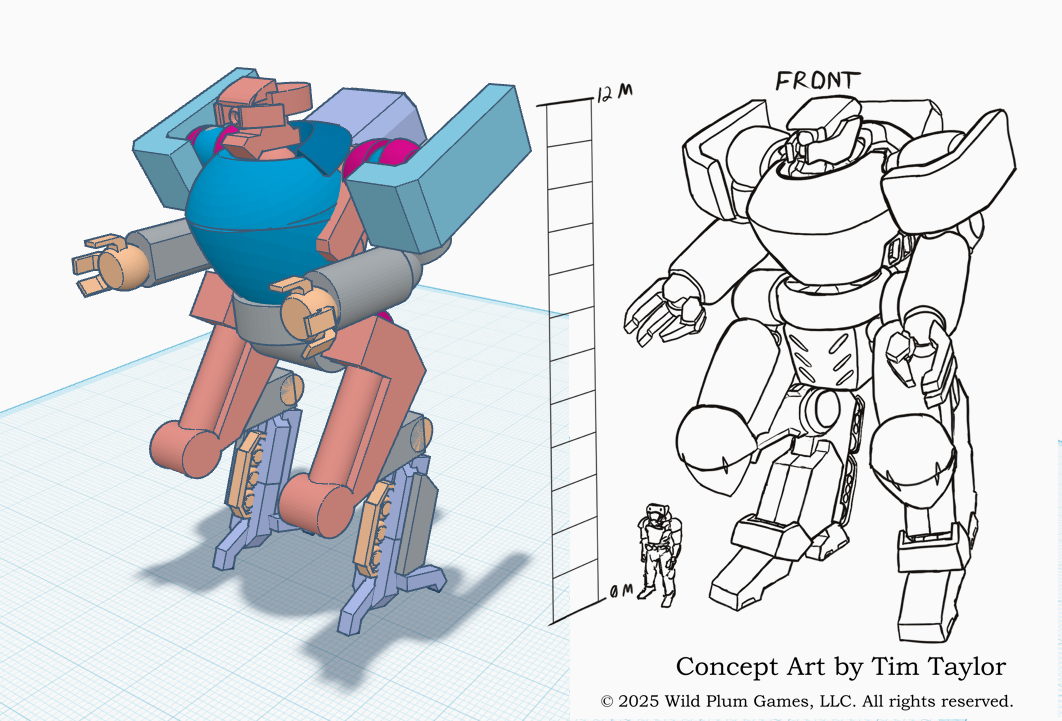
Tim Taylor (@cosmicflotsam on Bluesky) is the first visual artist I found to work on Precipice. He has an extensive background drawing mecha, including the standout designs of his Outer Era setting, and I knew right away that he’d be a good fit for defining the visual style of Arbelos. Last week, I talked about the origins of the M-Trak design, and today, I’m sharing a quick Q&A we did about his background, his taste in giant robots, and more!
Max: So Tim, how did you get started drawing robots?
Tim: I didn’t really start drawing robots predominantly until after the military. I started getting into digital art again once I was getting ready to return to civilian life.
I had been drawing since I can remember, and would draw levels from side-scrolling games like old-school Sonic. Later, I started drawing my own comics, and started drawing people unfortunately inspired by the art from Dragonball Z, which set me back in the human art department.
After the military, I went into university and did digital art and design there. When I started drawing robots, I felt the old flame of how I felt in high school, designing my own worlds. That’s how Outer Era got started.
M: During our conversations about drawing robots, you’ve often mentioned rotating robots in your head as you’re sketching them. Did you do anything in particular to practice this skill?
T: Probably the best thing for that was spending most of my teenage years obsessed with Gundam, and the figures and model kits that series offers. I would spend a lot of time just posing and staring at them. I didn’t realize it at the time, but I was training my brain to be able to visualize the forms more easily.
Now, I rotate different designs and shapes to go to sleep, or come up with different gimmicks and designs for robots. Sometimes, one will stand out the next day when I wake up.
Working digitally helps a lot with that, too, since I can resize and move objects as needed. I’ve been slowly building on applying this to my art for about 16 years now.
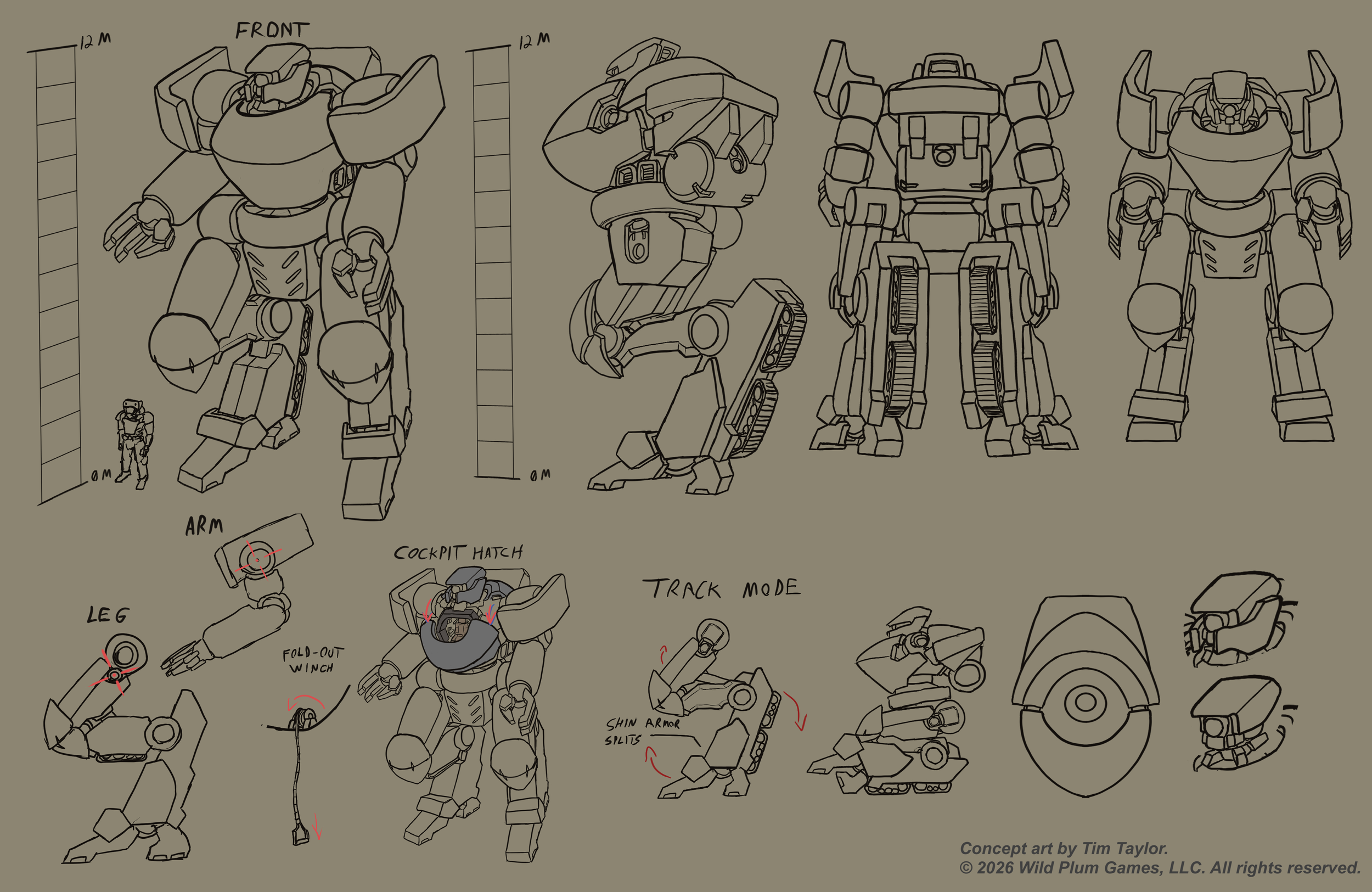
M: With the traks from Arbelos, I knew that I wanted a look that evoked the sloped armor of midcentury tanks and aircraft, and I really like the way you handled this. Were there any other visual inspirations you looked at while putting together the board of designs?
T: I did look up quite a few naval guns and tanks, treads, past and future. I even looked at some non-armored vehicles.
I also had this idea in my head – I don’t like to be one of those “Western vs Eastern” mecha types, since I think that’s a false dichotomy – a lot of MechWarrior was pulled from Japanese designs – but I tried to do what people might call a “Western-style” design that is a bit less Super Robot inspired. I also wanted the M-Traks to look a bit less like my usual styles, which are more Armored Core or Gundam.
M: M: I really like that M-Traks have that feel of being from that era when mecha was a bit less defined. They remind me of something from an obscure anime that could have been pulled for a BattleTech splatbook or another tabletop game in the 80s.
T: That’s high praise.
M: Beyond Gundam and Armored Core, are there any specific works or visual styles you like to look back to when you’re stuck or looking for ideas?
T: What experience I’ve had with Mechwarrior stands out, a little bit of Macross. Sonic the Hedgehog and Robotnik’s robots also stand out as an inspiration. Evangelion to a degree, even though those aren’t technically “mecha” – the equipment like the positron cannon and the assault rifles were really big for me as a kid. Cowboy Bebop’s ship designs also stand out. To this day, I really want a model kit of the Swordfish.
Another thing that occurs to me is that, having been in internet art communities since 2002, seeing other artists and their styles has been very influential. Mecha artists have to have very unique styles, and some of them can do any style as a result of having to do so many different styles. Folks like Maung Thuta, Muh Dipo, Johnson Ting, Michael Kus, Brian Sum to name a few.
M: Did you learn anything interesting about historical vehicles while researching for the traks or their weapon systems?
T: I was already fairly familiar with a lot of weapons and military vehicles because of my time in the service, where I would spend my downtime doing much of the same study I did with model kits as a teen. I was able to take visual cues and pull them in, so it was kind of natural to say “oh, this is how the manufacturing of this part would work, these are how the pieces fit together.”
I do find it very interesting that the M2 Browning machine gun has been in service since 1902, but the design is still in service. I handled one when I was in Iraq.
M: One thing I really like about working with you is that you push me, as a writer, to think about a lot of the physical details of the mechs. We had a really good conversation that I remember about the shape of the displacement drives, and you suggested twinning them, like an hourglass, which helped give the M-Trak its particular look.
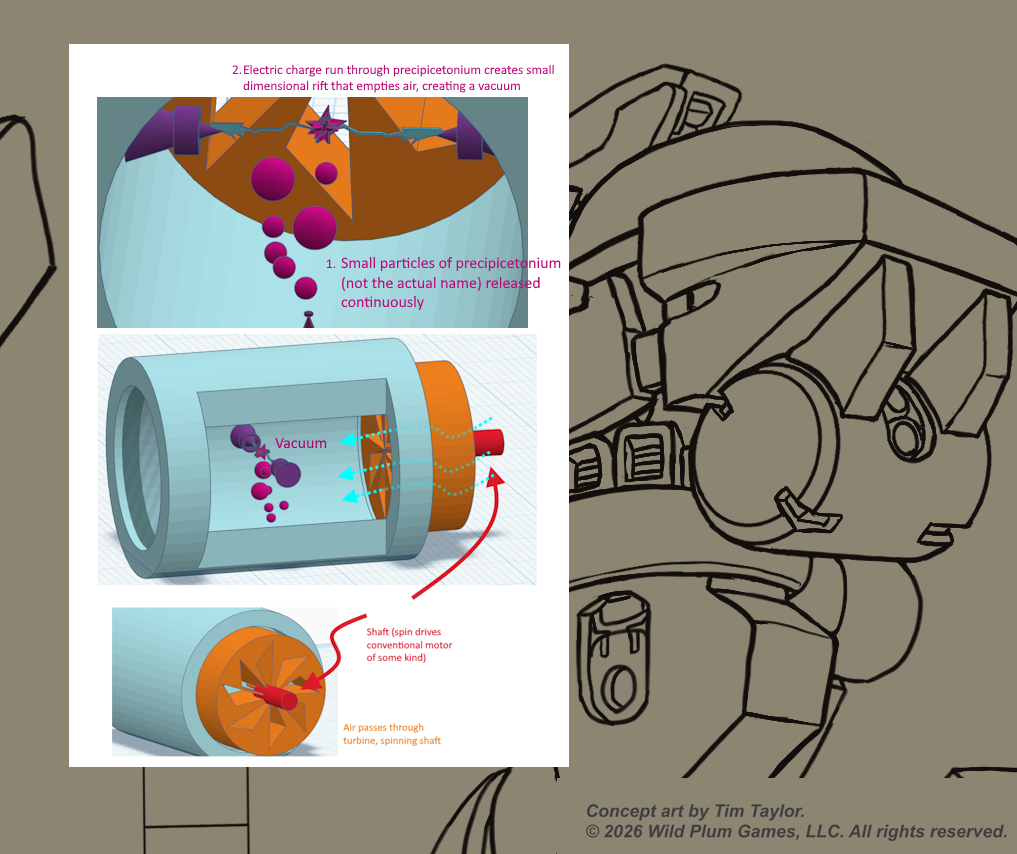
M: What are some physical details of the designs you’re particularly proud of?
T: Really for me, it’s everything coming together as a whole. I get a lot from bouncing ideas off other creatives. I did this with you, but I do this with other people, too.
One thing that was a conundrum for me was the tracks themselves, and how they’d transform from a walking mode to a rolling mode. I’m glad I was able to pull it off and make sure it didn’t break out of the “feasibility window” where it doesn’t feel believable to people. Nothing bugs me more than a mech that doesn’t make sense from a layman’s view.
With the traks, I tried to keep things simple and easy to manufacture. That’s part of why the legs in the traks confounded me so much!
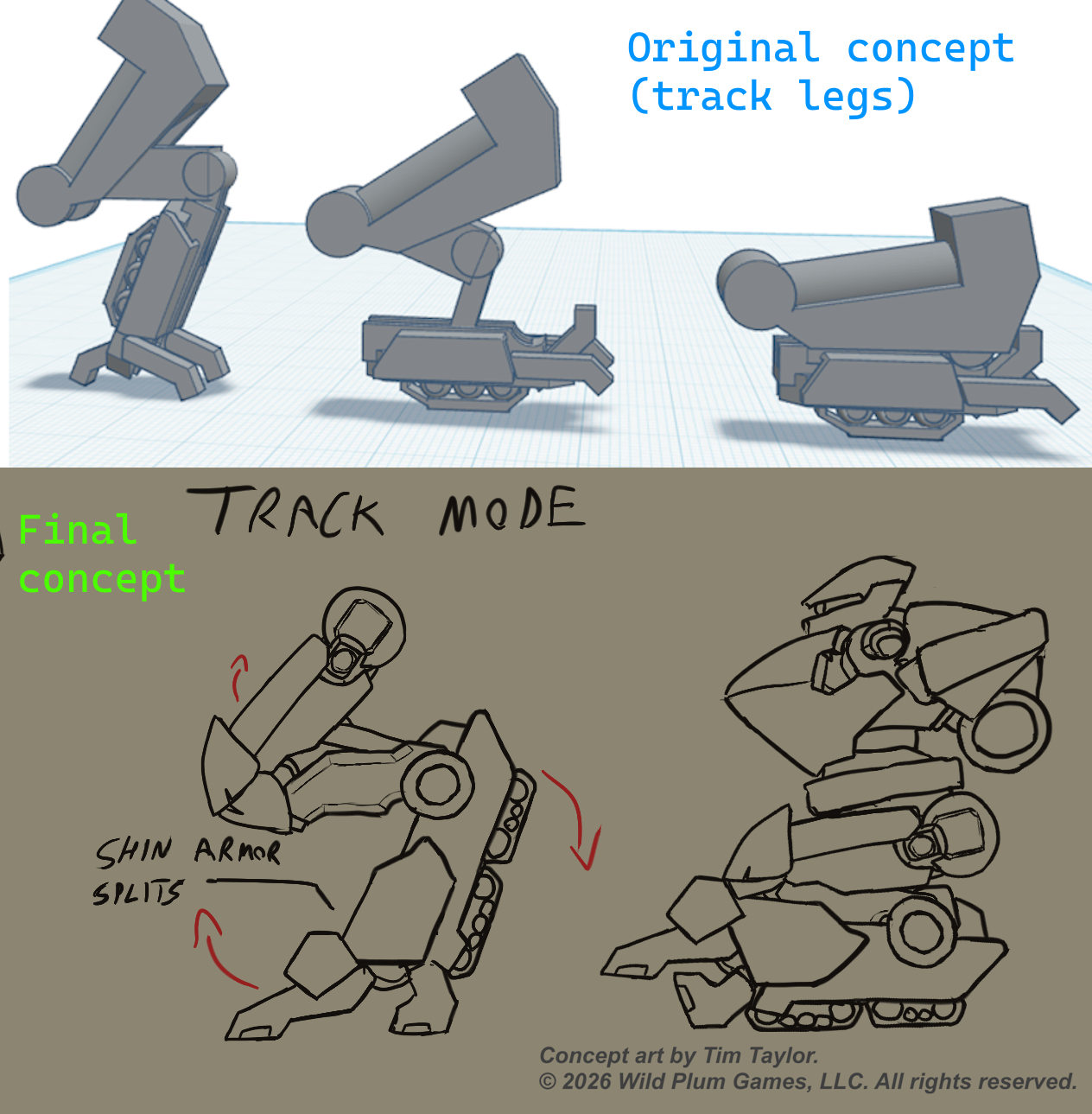
I can’t tell you how much I’ve thought about what the traks look like in motion. Just the idea that they can rove around as a stable vehicle makes me want to see them in more support roles too, like a supply hauler or construction.
M: Speaking of, are there any of the concepts we haven’t fully explored that you’d be really excited to revisit?
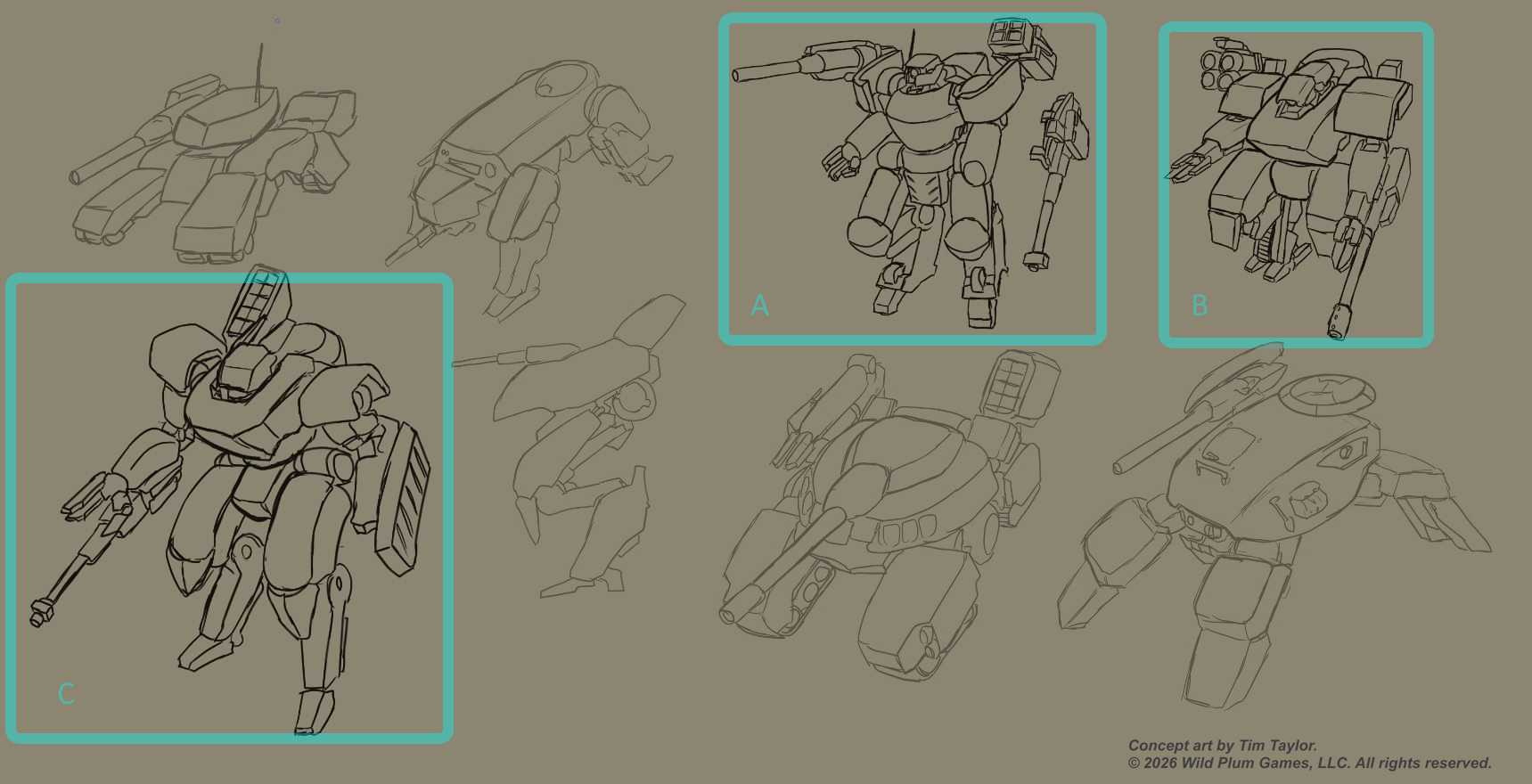
T: Plenty! One thing that is always in my mind is “what came before this” and “why did this arise”? I designed some that looked more tank-like, and some that were spider tanks. I like to think they started off closer to articulated tanks than actual robots.
I also designed some that were with alternate combat roles, and I’d love to explore more of those.
M: Any of your projects you want to plug while you’re here?
T: Mostly just my artwork itself [view on Bluesky], and my availability to spread out and work on more different projects as my time allows. Outer Era is more of a playground right now than it is a coherent property. I encourage people to do 3d models of my design, and I discuss the plotlines with my friends to build ideas, but it’s all very amorphous right now.
After this conversation, we went on to geek out about robot stuff for a bit longer. But you’ll have to wait for me to start a podcast to get that level of granular detail!