
World Interview: Introducing Michael Gernes’ Harness
When I set out to make Precipice, the first person I approached for world design was my longtime collaborator and Star Trek: Into the Unknown co-designer Michael Gernes (see his extensive resume on BoardGameGeek).
Michael and I have been friends since 2012, when he joined Fantasy Flight Games a few months after I began working as an RPG Producer. Unsurprisingly, we shared an interest in RPGs and miniatures games, but we also bonded over literature. And Michael also opened my eyes to a lot of iconic films I hadn’t watched growing up (Flash Gordon, Krull, Excalibur, and perhaps most importantly, Robot Jox, to name a few).
During our years at FFG and our collaborations thereafter, we often discussed concepts for settings that blended the literary hallmarks of science fiction and fantastical histories. From the squabbling interdimensional family politics of Roger Zelazny’s Amber series to the baroque worlds of Fading Suns and Battletech, we found a lot to talk about in this vein.
So even as I started to sketch out the earliest concepts of what Precipice would look like, I knew I wanted him to create something for it. And today, I’m proud to present a first peek at his work, some amazing concept art by the talented Anka Sep, and Michael’s own thoughts on the setting!
Max Brooke: With its early Renaissance-inspired visuals and story of social and political evolutions around the idea of statehood, the world of Harness has a very distinctive vision. What set you down this path for your setting?
Michael Gernes: A lot of things in a blender. Probably starting way back with my college interest in the Italian Renaissance—both its art and politics. That stuck with me for a long time. And over time I got more interested generally in how the frame of reference of pre-modern people about their own society is shaped by the context of their times.
Years later I got into armored combat with the Society for Creative Anachronism. I’d always been a fan of fantasy and historical armor and their aesthetics. And I’d always been a gamer, and saw armor through that lens. But that experience of both fighting and trying to portray a historical look in my kit really transformed my earlier impressions. It got me obsessing again about historical art and costume, but especially how it can differ from our modern conceptions about it.
So all that had been rolling around in my head until we talked about this project. And I realized it might be a great opportunity to explore that in speculative fiction!
MB: Obviously, one fantastical element is the great harnesses themselves. How did you think about giant robots factoring into this world?
MG: Well, I definitely started from the supposition that giant robotic suits existed in this late-medieval world, so how did that happen? How would a world that even resembled our history have that in it? And fortunately (probably not coincidentally) a lot of the tropes of mecha fiction lend themselves to a world where the highest-end personal armor is really expensive, relatively rare, and worn by champions for some state or cause.
I felt that the basis for the mecha’s power had to be something fantastical and magical, and scarce. And probably revered. But also that the people of those societies would inevitably put their craft and art into it in an aesthetic way. Like people did in our own history with churches and religious art. And that just seemed like a good metaphor.
And that also led me to thinking about what these things would fight in a fantasy world. Probably not just each other.
MB: How about the characters? How did you decide the sorts of people you wanted to focus on in the story?
MG: I realized pretty early I wanted the main character to be an artist. That came from what I read and watched about real history, and it felt right. Artists like Leonardo da Vinci dabbled in designing war machines. They rarely fought though, so there had to be a reason that an artist would end up piloting a mecha.
That led to other characters. I knew there had to be someone who trained the artist, and I thought that a mercenary would make sense and also roll that aspect of the setting into context. Which also made me think about the nature of their relationship and how they met.
There definitely also had to be someone with the power and interest to put the artist in a harness. I already wanted someone who could present the politics of the setting, because I’d been researching a lot about the real Renaissance. So that became my third character.
Finally, I knew I wanted a foil for the artist too, an enemy champion, and I thought a lot about them. But that character will show up more clearly in later stories, so I’ll leave that for then!
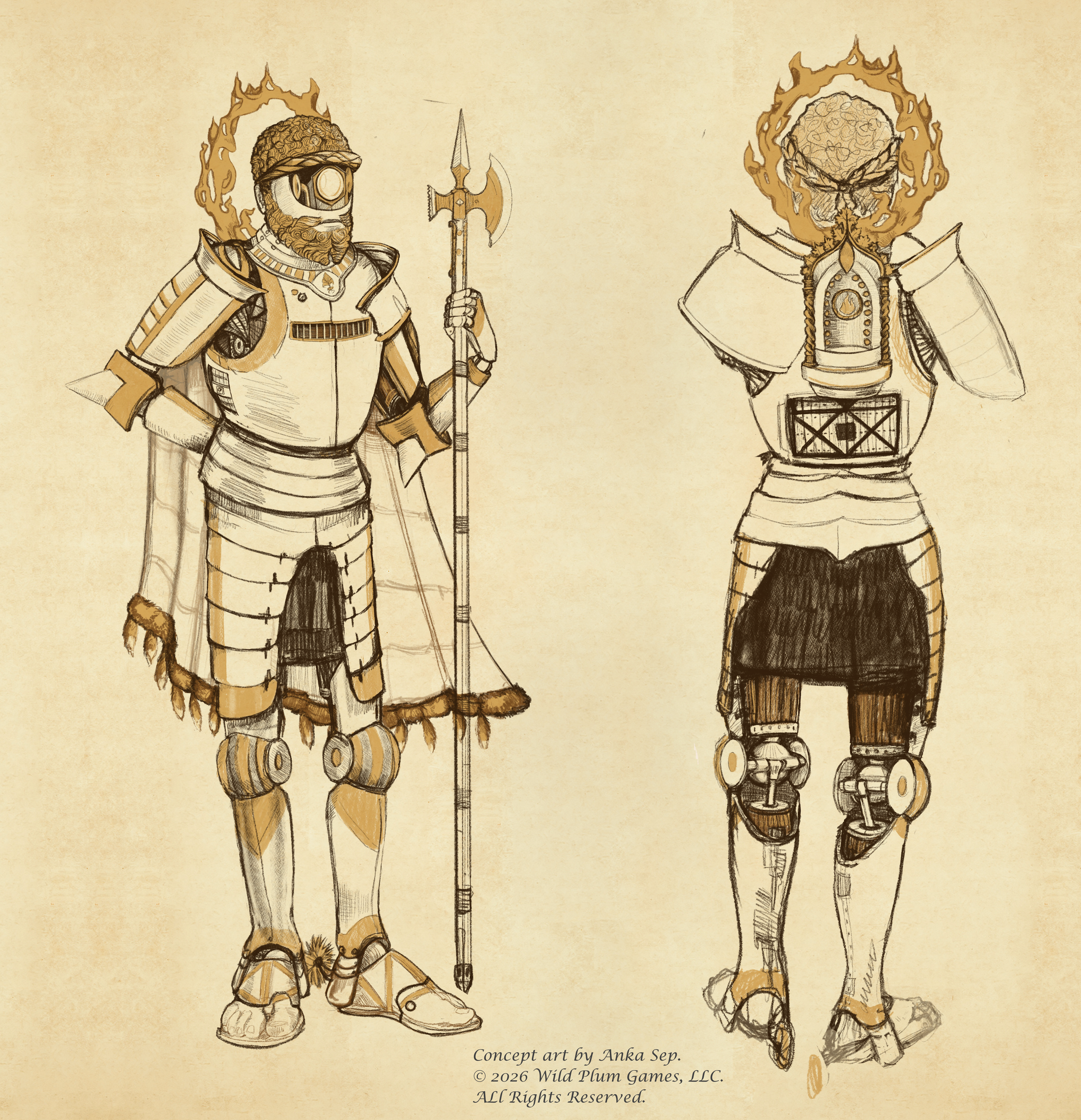
MB: I love the way the world’s history matters to the unfolding narrative, with relic of a past society as a key component of great harnesses and other technologies. What ideas did you want to evoke with the relationship between these ancient wonders and “modern” innovations in Harness?
MG: I wanted the world to have an antiquity that people would look back to with awe but also growing interest. They accept that things like the harnesses are possible, but don’t imagine them from a context of assumed technological progress. So there are ancient wonders they can’t eclipse but like to identify themselves with. And at the same time, I wanted there to be a sense of incremental change and growth happening in the present.
I wanted to capture just a little of the zeitgeist I get from reading modern histories of the Renaissance, like The Beauty and The Terror, which leave more tarnish and anxiety on that period.
MB: Obviously one element that is very different from our world is the matter of the Precipice. How did you think about the Precipice as part of the world of Harness?
MG: Once I knew I was writing a fantasy world, I knew the Precipice had to interact with it on a deep level. Like you mentioned, a lot of my favorite fantasy media hints at the existence of some kind of multiverse or greater cosmos, even if it’s just in passing. So I started thinking about what the Precipice meant to Harness early. How that would give access to possibilities beyond the confines of our reality and our physics. Possibility kind of became my watchword for thinking about the relationship and how it shaped Harness’ world.
I don’t want to say too much about details, because I think fantasy thrives on the unexplained. But my intention is to explore that relationship gradually over future stories.
MB: One thing I suspected would be helpful is your background doing original world-building work, thanks to your time on projects like the Runewars miniatures game. This game fleshed out a lot of new dimensions of Fantasy Flight’s classic Terrinoth setting. Are there any lessons you took from that project (or others developing new parts of IPs) that you found especially relevant to your work here?
MG: I realized that having a central narrative mythology is important as a backbone for the world—even if it’s not all reader facing. It helps define the themes you can return to. And when you connect new characters or stories to that later, it makes it feel more three (or four) dimensional.
I tried to do a little of that with Runewars by asking how a new faction or unit’s story could connect to the setting’s older throughlines. And I get really excited when I see other people do that with an existing IP.
I also realized I think in terms of institutions and broader cultural patterns in a fictional world. That helps me create characters and stories. I definitely work the other direction too sometimes. But understanding a society’s self-narrative helps me imagine specific people in it. Because I think individuals usually break pattern in some way, even if they have a lot of “typical” qualities.
MB: Speaking of the visual identity of Harness and some of it’s signifiers, are some visual touchstones that are especially important to you?
MG: I want the harnesses themselves to look a little closer to the source material—historical art, extant armor—and a little less like they’ve been run through the blender of modern stylization. Not to say that I don’t also love stylized fantasy armor! But I like the specificity of real armor. And how the aesthetic decisions of pre-modern people can sometimes appear odd when we try to apply post-industrial ideas to them.
I also wanted the harnesses to look like they’d be almost possible in a late-medieval world with something fantastical folded in. Like they could have come from a da Vinci sketch or a woodcut print of war machinery. Similar things apply to human costumes in Harness too.
Anka turned out to be the perfect visual partner for all that. They showed me a lot of historical armor pieces I wasn’t even aware of. They were really great at elaborating on my sometimes vague descriptions and helping iterate. And some of their art led me to new ideas for the fiction!
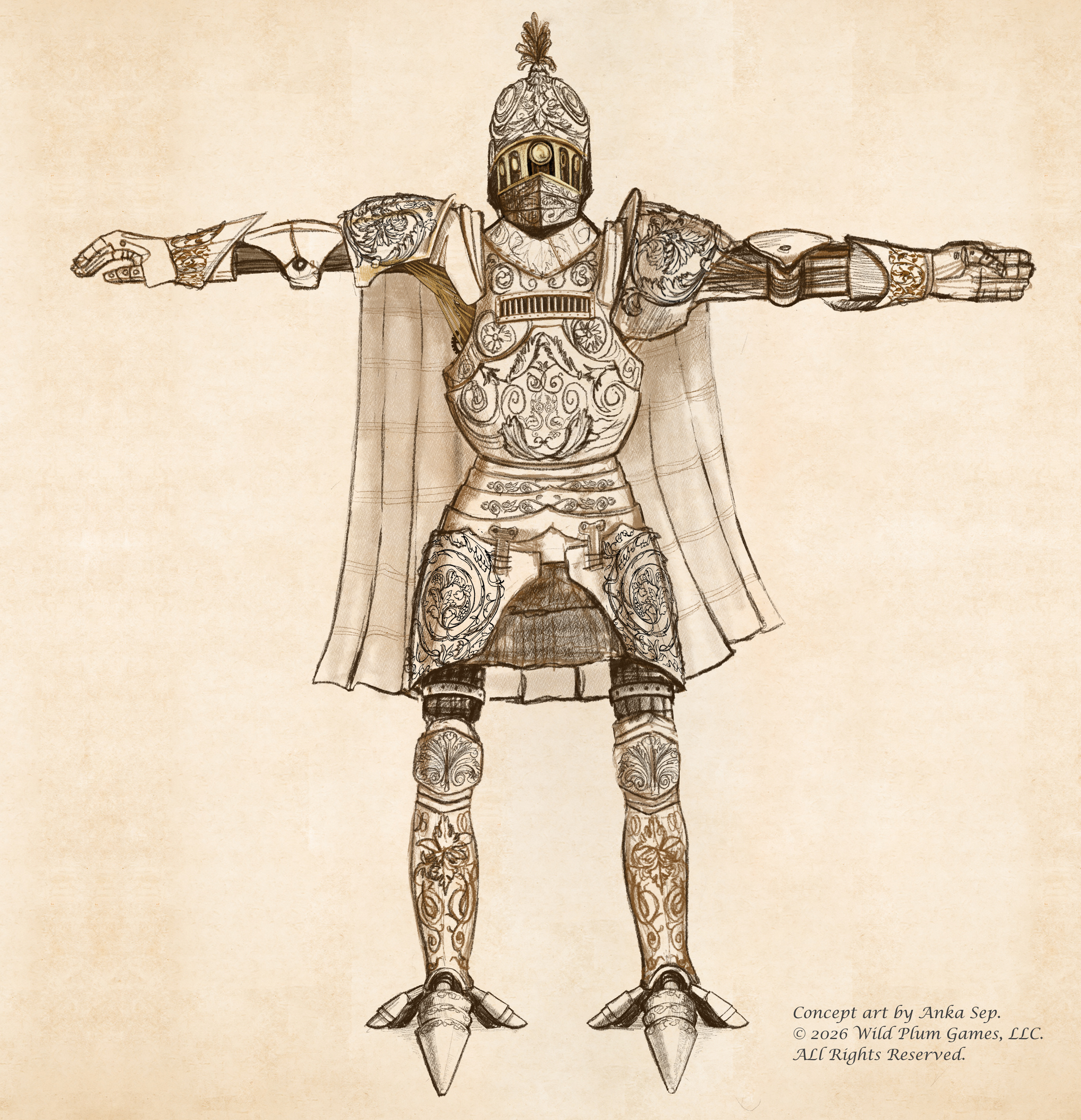
MB: Anka’s art really created an awesome visual direction for the setting. Once you two started deep-diving on historical artists like Filipo Negroli during that first phone call, I knew they were going to have some really great contributions to the visual direction of Harness and that this was going to be something special.
Turning to other historical inspirations, how has your background with historical combat helped you with Harness? I have to imagine it informs the opening pages of your story in a pretty direct way!
MG: I’d say the contradictions of going from intellectualizing armor to actually fighting in it. Because I was directly inspired to learn to fight by the fantasy novels I loved.
I became hyper aware of details like lacing points and straps. How armor shifted around me and its inertia pulled as I’d change direction. And the sweat, because I was always sweating after just a couple passes.
But as clumsy as I often felt, after practicing for months, time really did kind of slow down. I got more aware of my muscle movements and my limb angles without having to focus on them. And then on a (slightly) more conscious level I’d transition from a swing into a thrust to get over the top of an opponent’s shield.
It wasn’t the chess match I’d kind of expected; I’m not really a chess guy anyway. But it was more like my one season of tackle football, where I’d try to get fundamentals to line up with opportunity.
I just wanted to bring some of that experience across, even if it’s applied to strapping into a fantasy mecha.
MB: When you considered how the great harnesses might function strategically and societally, what did you think about? Were there any historical (or literary) parallels you considered?
MG: I tried to draw on separate strands in late medieval society.
Real armor, especially as worn by knightly cavalry, was ruinously expensive. But it was a priority for most late medieval states to compete militarily. It was also a major industry in places like Milan, and people spent resources beautifying it as a status symbol for the patron. And elite people actually engaged in personal combat in their armor (great example, King Richard III).
At the same time, artillery got better engineered and professionalized in that period, and was a sign of how nation-states could out-marshall these small but rich city-states. So in a way, at its peak knightly armor was already becoming weighted with its own mythology.
I also thought a lot about my visit to the domed cathedral in Florence, Italy. And how it was a civic project that lots of citizens touched in some way.
MB: While you’re here, are there any other projects you’d like to plug or other work of yours you’d like to point people toward?
MG: Not something I can talk about yet, but sometime in 2027 I’m hoping to help announce a pretty exciting project I’m on.
For fans of Star Trek: Into the Unknown, our next expansion Glory & Zeal introduces the Cardassians. I hope people have as much fun playing it as we did making it!
MB: That was a fun one to design! Machiavellian politics always make for fun game mechanics, whether the setting is fantasy or sci-fi. And I’ll be curious to hear more about this secret project in the future. We’ll have to follow up when it’s announced.
Thanks for taking the time to come on and offer some of your insights into the world of Harness!
If this interview piqued your interest, you can start reading the Harness stories today, right here!