
Mechanics Update: Head to Head
Mechs don’t have to have distinct heads, but humans love to see faces in things, and heads often follow. While the legs may give the machine a humanlike gait, the arms give it means to interact with the world, and the core gives it somewhere to attach everything, a head is a space to express personality. You can usually tell a mech’s narrative role by looking at its head. A more humanlike head reminds you of the person within or the people who crafted it. An more mechanical or functional head design might reinforce that the mech itself is an unfeeling tool. A skull-like design usually means you’re looking at an ominous presence within the story.
But this always leaves an interesting question for mecha works to answer. What does the head actually do? Sometimes, it houses the cockpit, but just as often that’s found in the torso. Oftentimes, it houses optics (following the human or animal body-plan), communications equipment, or secondary weapons (“teeth”, of sorts, often in the form of anti-personnel or light anti-armor weapons). Occasionally, it might have actual teeth (the more humanlike, the more disturbing).
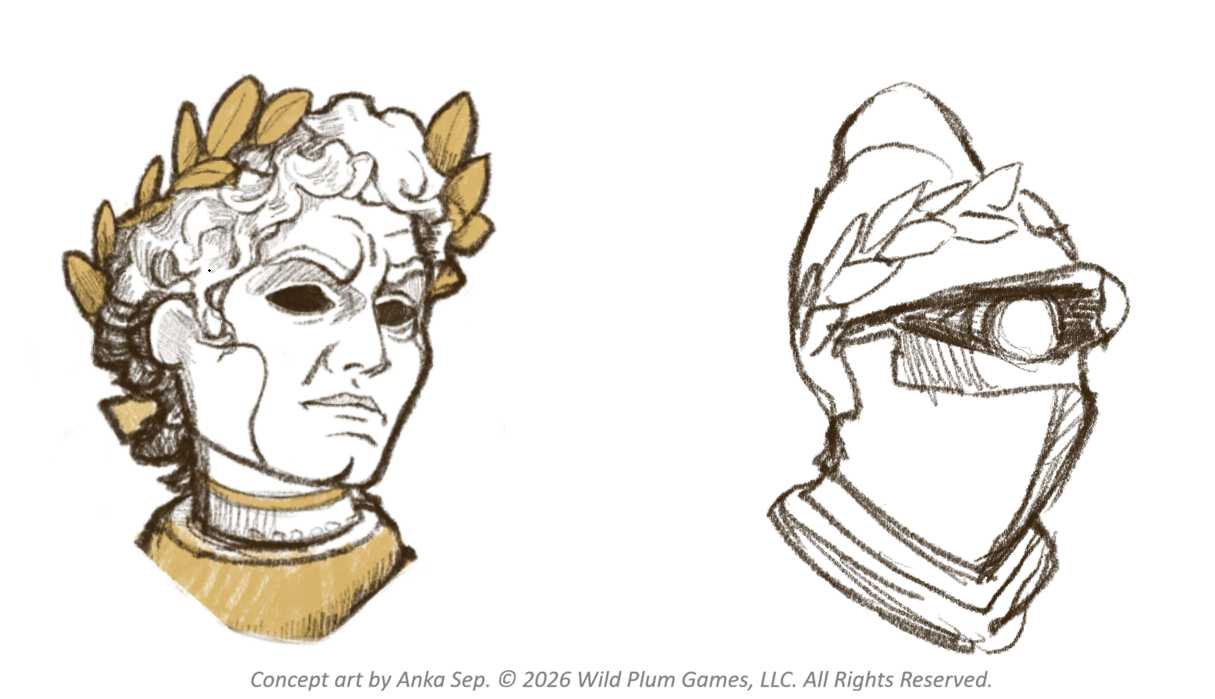
For Precipice, this question expressed itself through mechanics. Early on, there wasn’t much on the head besides slots for gear. This had a couple of consequences. First, it meant there wasn’t a lot to do with the head unless you’d chosen to equip it, which felt odd. I experimented with “observe”-type actions, but spotting in minis games is always a bit strange, because the player can (generally) see the whole board.
The knock-on effect was that because the defender assigns damage in Precipice, the head often served as ablative armor. This had a certain charm (and called to mind some famous scenes in mecha media), but ultimately didn’t feel right. The head is critical to the bodies the mech evokes, so it should matter if it gets lopped off at the start of every combat.
Over time, I found two answers to this problem.
The first came in a very early playtest. Andrew Fischer suggested that the Steer action, previously a tenant of the over-crowded legs, should probably go somewhere else. We discussed a few options, and both came to the conclusion that from a mechanical perspective, it should really be on the head. The bottom-up logic made sense, but what about top-down? Well, after some discussion, I was persuaded that this was a good way to reflect how the vision of the mech factors into its movement. After all, the better you can observe your environment, the easier it is to move around it. Losing the option to steer doesn’t make movement impossible, but it does make precise movement harder. This line of logic takes a small thematic jump, but one most testers have seemed willing to make.
The second came much later, during the design of the Preview Pack. I’d been testing with a very basic set of Parts and little customization. I’d known from the start that customization would be important, but I was starting to get a lot of test feedback that people wanted to see that aspect in action. That was a good sign that the core mechanics were working well enough to start iterating, so I did.
I started by creating three sets of “archetype” mech parts. Each archetype is meant to be put on the table quickly, supporting the Bring Your Own Mech playstyle. Supported by some awesome, evocative art by Javier Holguin, these parts don’t correspond to any specific mech from the worlds of Precipice, but instead serve as building blocks to help you get favorite mech miniatures in your collection to the table.
As I worked through the first three archetype mechs that appear in this pack, I kept mind that the heads available would signal a great deal about the archetype. And as one of the least crowded Parts, the head was a natural place for the “unique” abilities of these individual mech archetypes. So I leaned in on this. And while each head ability is particularly good with the parts to which it corresponds, it can also be leveraged for your own, unique creation.
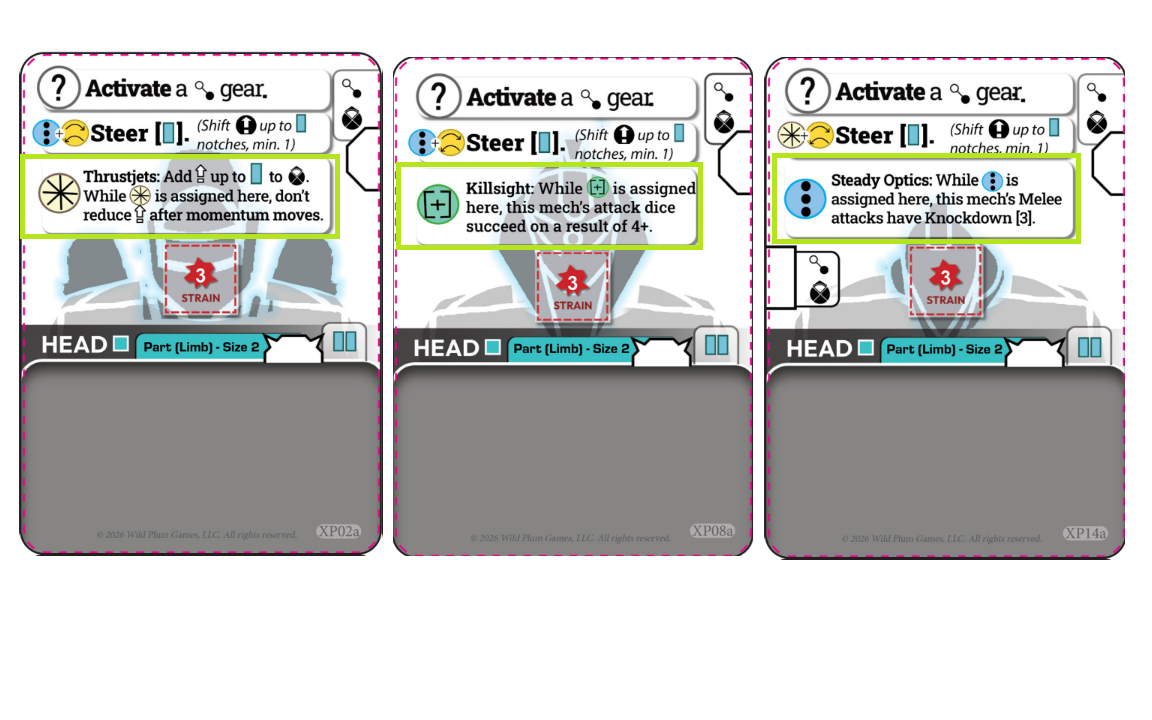
And this has set the design direction for the head moving forward. Each head has a particular active ability that helps give shape to the overall mech build. The head isn’t the first thing you pick out when building your mech (that’s the core), but it’s a key decision in your build. For mechs that have heads, anyway (because not all of them will)!
You can find printer-friendly versions these archetype parts as part of the Open Alpha.